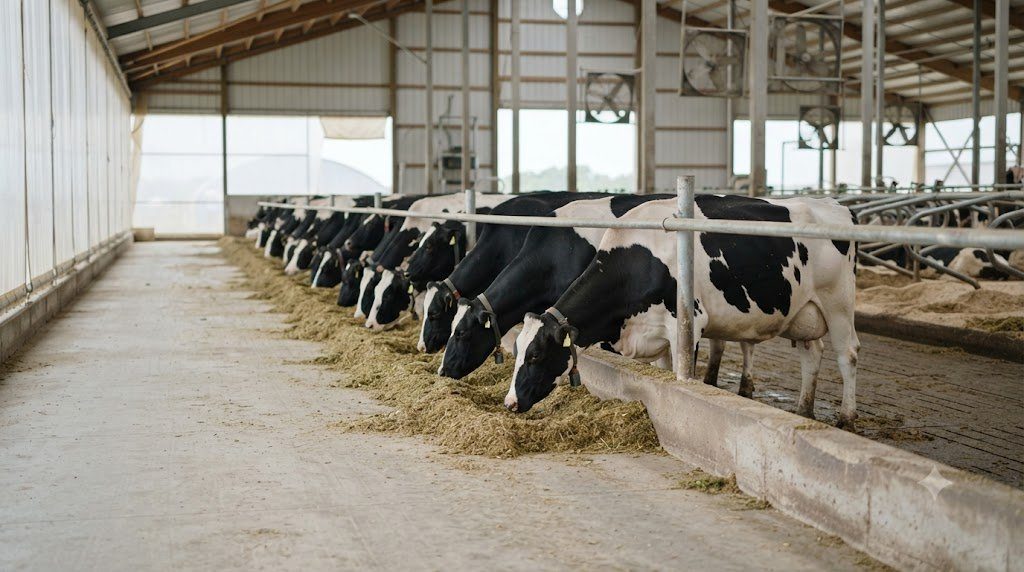
- Balancing Neutral Detergent Fiber (NDF), physically effective NDF (peNDF), and non-fiber carbohydrates (NFC) to optimize ruminal fermentation and avoid acidosis.
- Implementing the Dietary Cation-Anion Difference (DCAD) strategy during the close-up dry period to eliminate clinical and subclinical milk fever.
- Managing the critical transition window (3 weeks pre-calving to 3 weeks post-calving) to prevent hepatic lipidosis and clinical ketosis.
- Formulating Total Mixed Rations (TMR) with precision moisture control, particle size distribution, and forage-to-concentrate ratios.
- Optimizing water quality and flow rates, ensuring 35 to 50 gallons of fresh, accessible water per cow daily to sustain peak lactation volume.
1. Ruminant Digestive Physiology and Energy Kinetics in High-Yielding Dairy Cows
A high-producing dairy cow yielding 80 to 120 pounds of milk daily is one of the most metabolically demanding animals in commercial agriculture. Understanding dairy nutrition requires conceptualizing the cow not as a single organism, but as a symbiotic fermentation chamber containing billions of anaerobic bacteria, protozoa, and fungi within the rumen. The primary nutritional objective is maximizing microbial crude protein synthesis while maintaining a stable ruminal pH between 6.2 and 6.8.
Dietary carbohydrates represent the primary energy fuel for lactation. These are classified into structural carbohydrates—measured as Neutral Detergent Fiber (NDF) and Acid Detergent Fiber (ADF)—and Non-Fiber Carbohydrates (NFC), which include starches, sugars, and pectins. Rumen microbes ferment starches and soluble sugars rapidly into volatile fatty acids (VFAs): acetate, propionate, and butyrate.
Propionate is transported via the portal vein to the liver, where hepatic gluconeogenesis converts it into blood glucose. The mammary gland utilizes over 80% of systemic glucose to synthesize lactose, the primary osmotic driver that pulls water into milk. Meanwhile, acetate and butyrate serve as precursors for mammary de novo fatty acid synthesis, governing milk butterfat percentage. Maintaining an optimal acetate-to-propionate ratio (exceeding 2.2:1) is essential to preserve butterfat tests while fueling milk volume.
Physically Effective Fiber (peNDF) and Subacute Ruminal Acidosis (SARA)
To achieve high caloric density in early lactation, nutritionists often elevate dietary starch to 26% to 30% of dry matter. However, excessive starch combined with inadequate physically effective NDF (peNDF) accelerates lactic acid production and VFA accumulation, dropping ruminal pH below 5.8. This triggers Subacute Ruminal Acidosis (SARA).
SARA compromises the ruminal epithelial barrier, damages papillae, and releases bacterial endotoxins into systemic circulation, leading to severe laminitis, sole ulcers, liver abscesses, and butterfat depression. Rations must contain a minimum of 28% to 32% total NDF, with at least 21% of dry matter derived from forage NDF. Monitoring particle length using the Penn State Particle Separator ensures 8% to 12% of the TMR remains on the top sieve (>19 mm) to stimulate chewing, cud regurgitation, and endogenous bicarbonate secretion via saliva.
Aim for 8-12% on the top screen, 45-55% on the middle screen, 30-40% on the lower screen, and less than 5% in the bottom pan. Excessive fine particles (<4 mm) predispose cows to SARA, while overly long particles encourage feed sorting.
2. The Critical Transition Cow Period: Biology and Nutritional Protocols
The transition period—spanning 21 days prior to calving through 21 days postpartum—is the single most decisive phase in a dairy cow’s productive life. Over 75% of clinical health disorders (hypocalcemia, ketosis, displaced abomasum, retained placenta, and metritis) occur during this 42-day window.
During the far-off dry period (60 to 22 days before calving), cows require low-energy, high-bulk rations (approx. 0.58 to 0.60 Mcal/lb NEL) based on straw and mature grass hay to maintain rumen volume without gaining excessive adipose tissue. Cows that calve at a Body Condition Score above 3.5 exhibit sharp post-calving appetite depression, triggering excessive mobilization of non-esterified fatty acids (NEFAs) from body fat stores.
In the close-up phase (final 21 days pre-calving), Dry Matter Intake naturally drops by 20% to 30% due to fetal abdominal expansion and hormonal shifts. The close-up ration must gently increase nutrient density, introducing controlled amounts of corn silage and bypass protein to prepare ruminal papillae for the high-energy lactation diet.
Negative DCAD Nutrition for Hypocalcemia Prevention
Clinical milk fever (serum calcium < 5.5 mg/dL) and subclinical hypocalcemia (serum calcium 5.5 - 8.0 mg/dL) affect up to 50% of multiparous dairy cows at calving. Hypocalcemia impairs smooth muscle function, leading to uterine inertia, abomasal atony, and teat sphincter failure.
Implementing a Negative Dietary Cation-Anion Difference (DCAD) diet during the close-up 21 days is the gold standard preventative strategy. The DCAD equation—calculated as (Na + K) – (Cl + S) in mEq/100g DM—is adjusted to a negative value (-8 to -12 mEq/100g) by feeding anionic mineral salts (magnesium chloride, calcium sulfate) or commercial hydrochloric acid-treated bypass proteins. This induces mild metabolic acidosis, which upregulates parathyroid hormone receptor sensitivity and enhances bone calcium resorption. Monitoring urine pH (targeting 5.8 to 6.2 for Holsteins; 5.5 to 6.0 for Jerseys) 48 hours after introducing anionic salts confirms successful acidification.
3. Total Mixed Ration (TMR) Formulation, Delivery, and Bunk Management
Modern commercial dairies deliver nutrients via a Total Mixed Ration (TMR), where forages, grains, protein meals, minerals, and liquid feeds are mechanically blended into a homogeneous mixture. The primary goal of TMR feeding is ensuring that every bite the cow consumes represents a nutritionally balanced diet, preventing individual feed component sorting.
TMR moisture management is critical. Optimal TMR dry matter ranges between 48% and 54%. Rations exceeding 58% dry matter facilitate sorting of small grain and mineral particles, while overly wet rations (<42% DM) can depress total intake due to fermentation acids. Adding water, liquid whey, or molasses to dry rations improves particle adhesion and increases ration palatability.
Bunk management protocols require delivering fresh feed at consistent daily times, coinciding with return from the milking parlor when cows are hormonally stimulated to eat. Push-ups should be conducted 8 to 12 times daily to keep feed within reach. Target feed refusals (weigh-backs) of 2% to 4% for mature lactating strings ensure feed availability is never the limiting factor for milk production.
4. Protein Fractions: Rumen Degradable (RDP) vs. Rumen Undegradable (RUP)
Dairy cattle protein requirements are divided into Rumen Degradable Protein (RDP) and Rumen Undegradable Protein (RUP or bypass protein). RDP is metabolized by rumen microbes into ammonia and peptides, fueling microbial protein synthesis. Microbial protein possesses an amino acid profile closely matching that of milk protein and represents 55% to 65% of the total amino acid supply reaching the small intestine.
However, in high-producing cows (>85 lbs milk/day), microbial protein alone cannot fulfill amino acid demands. High-quality RUP sources—such as heat-treated soybean meal, blood meal, or corn gluten meal—must be incorporated to supply essential limiting amino acids: methionine and lysine.
Ration formulation models balance intestinal digestible lysine and methionine at an optimal 3.0:1 ratio. Supplying rumen-protected methionine and lysine allows nutritionists to reduce overall crude protein from 17.5% down to 15.5% – 16.0% without sacrificing milk or protein yield. This reduction lowers blood urea nitrogen (BUN), improves reproductive conception rates, and significantly reduces environmental ammonia emissions.
5. Fresh Water Infrastructure and Quality Parameters
Water is the most abundant and critical nutrient in dairy production. Milk comprises approximately 87% water, and a high-yielding cow consumes 35 to 50 gallons of water daily, with consumption doubling during periods of heat stress (Temperature-Humidity Index > 68).
Watering troughs should provide a minimum of 3.5 to 4 inches of linear water perimeter per cow in the group, with at least two watering locations per pen to prevent dominant cows from monopolizing access. Waterers must be positioned immediately adjacent to the milking parlor exit lanes and within 50 feet of all feeding alleys.
Water quality must be tested annually for Total Dissolved Solids (TDS), sulfates, nitrates, and iron. Elevated sulfates (>500 mg/L) cause osmotic diarrhea and competitively inhibit copper and selenium absorption, while high iron levels (>0.3 mg/L) impair water palatability and catalyze oxidative stress in early lactation cows.
6. Metabolic Disease Prevention: Ketosis, Fatty Liver, and Liver Health
The metabolic transition of high-producing dairy cows centers upon the liver’s capacity to process mobilized non-esterified fatty acids (NEFAs). When early-lactation energy demands exceed dietary dry matter intake, hormonal cascades trigger lipolysis from adipose tissue reserves. These circulating NEFAs enter the liver, where they follow three distinct physiological pathways: complete oxidation to carbon dioxide and ATP, partial oxidation yielding ketone bodies (beta-hydroxybutyrate, acetoacetate), or esterification into triglycerides.
Bovine hepatic tissue possesses an inherently low capacity for synthesizing and secreting very-low-density lipoproteins (VLDL), which are the essential carriers required to export triglycerides back into systemic circulation. Consequently, when NEFA influx exceeds oxidative capacity, triglycerides accumulate within hepatocytes, leading to hepatic lipidosis (fatty liver syndrome). Fatty liver severely impairs hepatic gluconeogenesis, exacerbating systemic hypoglycemia and creating a vicious metabolic cycle that depresses appetite further.
Preventative herd protocols require routine weekly monitoring of blood beta-hydroxybutyrate (BHBA) concentrations using handheld clinical ketone meters on all cows between 4 and 14 days in milk (DIM). Herds should maintain subclinical ketosis (BHBA ≥ 1.2 mmol/L) prevalence below 10%. Cows testing positive should receive immediate oral drenching with 300 mL of USP propylene glycol daily for 3 to 5 consecutive days to provide an immediate glucose precursor, coupled with intramuscular injections of Vitamin B12 to stimulate the methylmalonyl-CoA mutase pathway in hepatic propionate metabolism.
7. Margin Over Feed Cost (MOFC) and Feed Efficiency Economics
In modern commercial dairy operations, feed costs represent 45% to 60% of total gross milk revenue. Maximizing net profitability requires shifting focus from gross volumetric milk production to Margin Over Feed Cost (MOFC). MOFC is calculated as: Gross Milk Income per Cow per Day minus Total Feed Cost per Cow per Day.
Feed efficiency—measured as pounds of 3.5% fat-corrected milk (FCM) produced per pound of dry matter intake (DMI)—serves as the primary operational benchmark. Healthy, well-managed Holstein herds should achieve a whole-herd feed efficiency of 1.50 to 1.70 lbs milk per lb DMI, with peak early-lactation pens frequently exceeding 1.75 to 1.90. A herd producing 85 lbs of milk on 53 lbs of DMI demonstrates superior economic efficiency (1.60) compared to a herd consuming 60 lbs of DMI to achieve the same 85 lbs (1.41 efficiency).
Routine forage analysis, weekly dry matter adjustments of silages, minimization of bunk refusals (targeting 2% to 3%), and prevention of feed spoilage along silo faces preserve vital margins. Implementing precision feeding systems ensures nutrients are allocated specifically according to production strings, eliminating costly overfeeding of late-lactation cows while sustaining the genetic potential of elite early-lactation producers.
Nutritional Specifications for High-Producing Lactating Dairy Cows
The following nutritional parameters delineate target dietary concentrations for early, mid, and late lactation Holsteins:
Frequently Asked Questions: Practical Livestock Management
❓ How does subclinical ketosis impact commercial dairy economics?
Subclinical ketosis (defined as blood beta-hydroxybutyrate [BHBA] between 1.2 and 2.9 mmol/L) affects 40% to 60% of fresh cows. Each case costs an estimated $289 due to lost peak milk yield (averaging 300 to 500 lbs over lactation), a 3-fold increased risk of displaced abomasum, and reduced first-service conception rates.
❓ What is the recommended protocol for treating acute clinical hypocalcemia?
Acute downer cows exhibiting clinical milk fever require immediate intravenous administration of 500 mL of 23% calcium borogluconate warmed to body temperature. Infusion must occur slowly over 15 to 20 minutes while monitoring cardiac rhythm. Follow up with oral calcium boluses at 12 and 24 hours post-treatment to prevent rebound hypocalcemia.
❓ Why is sodium bicarbonate added to dairy cow rations?
Sodium bicarbonate acts as an exogenous ruminal buffer. Included at 0.75% to 1.0% of total dietary dry matter, it neutralizes excess ruminal acidity produced during the fermentation of high-starch grains, maintaining rumen pH above 6.2 and sustaining milk fat synthesis.
❓ How often should silage dry matter be tested on a commercial dairy?
Silage dry matter should be evaluated at least once or twice weekly using a Koster moisture tester, microwave, or near-infrared (NIR) analyzer. Rain events or silo face variations change silage water content; failing to adjust mixer wagon wet weights leads to underfeeding forage and triggers digestive upset.
Summary: Comprehensive Implementation Protocols
To successfully integrate these management practices, livestock producers must balance biological animal needs with physical infrastructure and strict financial accountability. Routine observation, objective record-keeping, and preventative herd health protocols yield sustained enterprise longevity, reduced veterinary interventions, and consistent farm profitability across seasonal cycles.