- Selecting appropriate beef genetics (Angus, Hereford, Charolais, Red Poll) tailored to local precipitation, forage availability, and marketing channels.
- Designing intensive rotational grazing matrices with 1-to-3 day paddock shifts to optimize Dry Matter Intake (DMI) and pasture sward regrowth.
- Formulating targeted backgrounding and finishing rations balancing Total Digestible Nutrients (TDN) and Crude Protein (CP).
- Executing comprehensive preventative herd health protocols including clostridial vaccinations, external parasite mitigation, and low-stress handling.
- Maintaining detailed records on Average Daily Gain (ADG), adjusted weaning weights, and feed conversion efficiency to maximize gross margins.
1. Strategic Breed Selection and Genetic Architecture for Commercial Beef Production
Commercial beef cattle operations represent a long-term capital investment where genetic selection directly dictates reproductive longevity, feed efficiency, carcass grade, and overall operational resilience. The global beef industry is historically divided between British (Bos taurus taurus), Continental European, and tropically adapted (Bos taurus indicus / Sanga) genetics. Choosing the right breed composition requires evaluating environmental stressors, available forage quality, and regional finished meat market specifications.
British breeds—predominantly Aberdeen Angus and Hereford—have established global dominance due to their superior intramuscular marbling, moderate frame scores, early physiological maturity, and exceptional maternal instincts. Black Angus cattle command premium pricing across grid marketing systems due to branded beef incentives rewarding high USDA Prime and Choice yield grades. Red Angus and Polled Herefords offer comparable carcass merits with enhanced docility and maternal longevity, thriving in extensive temperate grassland environments.
Continental European breeds, including Charolais, Limousin, and Simmental, are structurally characterized by heavy muscling, expansive frame sizes, and leaner carcass yields. While purebred Continental cattle demonstrate rapid post-weaning Average Daily Gain (ADG) exceeding 3.5 to 4.2 pounds per day in feedlot environments, their substantial mature cow size (frequently exceeding 1,500 to 1,700 pounds) elevates annual nutritional maintenance requirements. Consequently, progressive cattlemen utilize Continental sires as terminal crosses over British-based commercial dam lines, capturing substantial hybrid vigor (heterosis) without inflating maternal herd feed costs.
Maternal Heterosis and Terminal Sire Systems
Commercial crossbreeding programs exploit heterosis to achieve cumulative performance gains across lowly heritable traits such as cow longevity, conception rates, and calf survival. A foundational terminal cross involves mating F1 Hereford-Angus (Black Baldy) females to a homozygous polled Charolais bull. The resulting calf crop expresses maximum heterosis for weaning weight and carcass muscle mass, while the maternal cows exhibit superior fertility, sound udder conformation, and sustained calf weaning percentages exceeding 92% over productive lifespans of 8 to 11 years.
In arid, subtropical, or drought-prone regions subject to severe heat stress and tick-borne haemoparasites, introducing tropically adapted genetics (such as Brahman, Santa Gertrudis, or Beefmaster) is essential. Incorporating 25% to 37.5% Bos indicus blood provides dense sweat gland concentration, loose vascular skin folds for thermal dissipation, and systemic resistance against external ectoparasites without compromising structural carcass tenderness.
Target moderate frame scores between 5.0 and 6.0 (mature cow weight of 1,200 to 1,350 lbs). Oversized cows (frame 7+) demand 20% to 28% more winter forage maintenance, reducing overall stocking capacity per hectare without delivering proportional calf weaning weight returns.
2. High-Density Rotational Grazing: Sward Dynamics and Forage Allocation
Pasture forage is the most cost-effective nutritional input for commercial beef cattle. Converting standing pasture biomass into finished beef requires an intimate understanding of photosynthetic rest periods, root carbohydrate reserves, and cattle grazing behavior. Traditional continuous grazing—where animals maintain unrestricted seasonal access to entire pastures—invariably leads to selective overgrazing of palatable legumes, severe soil compaction along riparian zones, and progressive weed infestation.
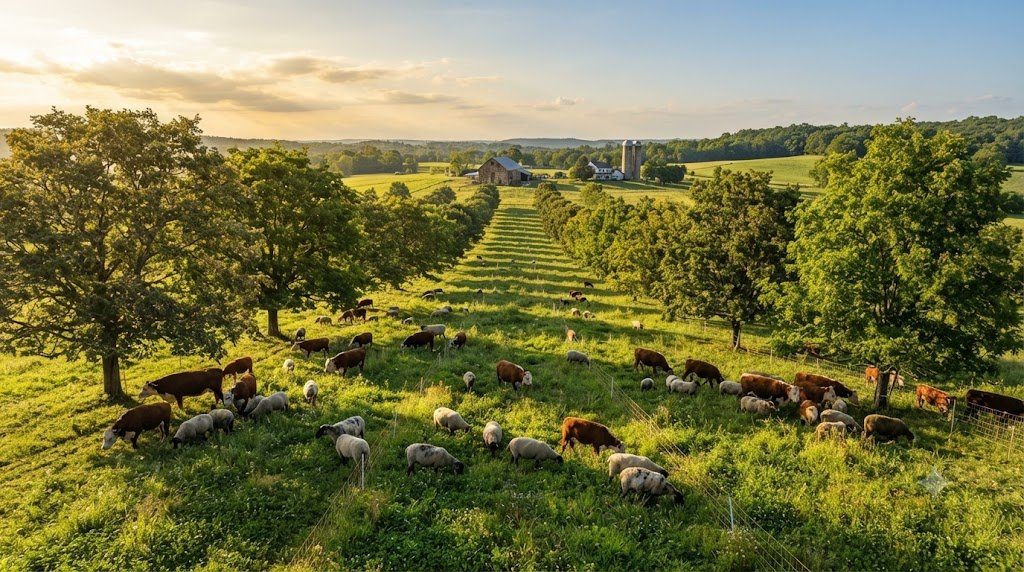
Management-intensive Grazing (MiG) partitions pastures into discrete paddocks utilizing temporary polywire and high-tensile electric fencing. Cattle are stocked at high instantaneous densities (50,000 to 150,000 pounds of live animal weight per acre) for durations of 24 to 72 hours before moving to fresh forage. This high stock density forces non-selective grazing, induces uniform manure and urine nutrient deposition across the field, and stimulates rapid plant tillering.
Optimal grazing entrance targets occur when cool-season perennial grass swards (orchardgrass, tall fescue, smooth bromegrass) reach 8 to 12 inches in height, corresponding to physiological stage 2 vegetative maturity. Grazing must cease when residual stubble heights reach 3.5 to 4 inches. Leaving this residual photosynthetic leaf area protects the crown of the plant, buffers surface soil temperatures, and ensures root systems remain active without drawing down critical crown carbohydrate reserves.
Calculating Dry Matter Allocation and Stocking Density
A beef cow consuming high-moisture pasture requires approximately 2.5% to 3.0% of her live body weight in Dry Matter Intake (DMI) daily. For a herd of 50 mature cows averaging 1,300 pounds each, total herd live weight equals 65,000 pounds. Daily herd DMI requirements are calculated as 65,000 lbs × 0.026 = 1,690 pounds of forage dry matter per day.
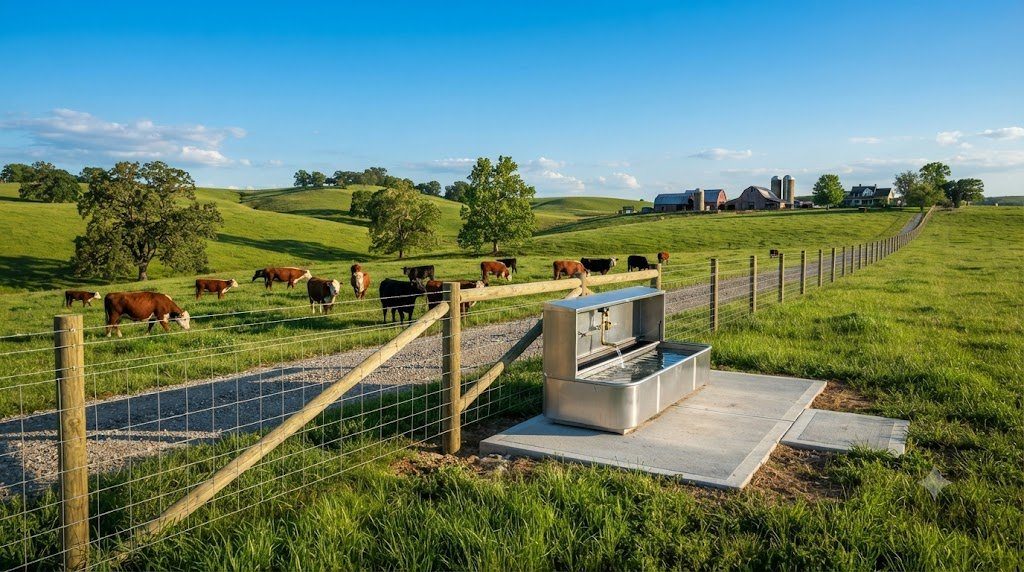
If a grazing sward measures 10 inches tall with an estimated density of 300 pounds of dry matter per acre-inch, total standing biomass is 3,000 pounds per acre. Targeting a 50% grazing harvest efficiency (‘take half, leave half’ rule), 1,500 pounds of consumable DMI is available per acre. Dividing the daily herd requirement (1,690 lbs) by the available forage yield (1,500 lbs/acre) dictates a daily paddock allocation of 1.13 acres (approx. 49,200 sq ft). Providing fresh water via portable poly pipe and quick-coupling trough valves prevents cattle from returning to previously grazed zones, preserving fresh regrowth.
3. Beef Cattle Nutrition: Backgrounding, Stocker, and Grass-Finishing Protocols
Following weaning at approximately 6 to 8 months of age, beef calves enter either a backgrounding/stocker phase designed to build skeletal frame and muscle mass through economical forage, or transition into high-energy finishing rations. Nutritional protocols must maintain continuous positive metabolic momentum; periods of nutritional restriction impair intramuscular fat adipocyte development and permanently compromise finished meat tenderness.
Weaned calves (450 to 600 pounds) possess a rumen capacity that limits dry matter intake of low-quality coarse forages. Backgrounding rations must deliver 13% to 15% Crude Protein (CP) and 64% to 68% Total Digestible Nutrients (TDN) to sustain targeted gains of 1.75 to 2.25 pounds per day. Rations typically incorporate high-quality grass-legume baleage, corn silage supplemented with distillers grains (DDGS), or cereal grain winter cover crops (cereal rye, triticale, winter wheat).
Grass-finishing requires immaculate forage management to deliver finished 1,150 to 1,250-pound steers at 20 to 24 months of age with adequate fat cover (minimum 0.35 to 0.45 inches of backfat over the 12th rib). To achieve finishing ADGs of 2.2 to 2.8 pounds per day without grain, pastures must contain high-energy, low-fiber vegetative forages such as annual ryegrass, crimson clover, chicory, and brassicas delivering over 68% to 72% TDN. If forage energy density drops during midsummer slumps, non-starch fiber supplements (soybean hulls or beet pulp) should be introduced to prevent fat mobilization and preserve carcass grade.
Macromineral Balancing and Ruminal Fermentation Modifiers
Free-choice mineral supplementation is essential year-round. A complete beef cattle mineral mix should provide a 2:1 Calcium-to-Phosphorus ratio, 8% to 12% salt, and chelated trace minerals (copper, zinc, selenium, cobalt). High-magnesium mineral mixes (minimum 10% to 14% magnesium oxide) must be introduced 30 days prior to spring pasture turn-out to prevent hypomagnesemic tetany (grass tetany) caused by rapid consumption of lush, high-potassium spring grasses.
In non-organic commercial systems, inclusion of an ionophore (such as monensin or lasalocid) within mineral formulations selectively suppresses Streptococcus bovis and other acetate-producing rumen microbes. This shifts ruminal fermentation toward propionate production, boosting feed energetic efficiency by 8% to 12% while virtually eliminating subclinical bloat and coccidiosis.
4. Preventative Herd Health, Vaccination, and Parasite Mitigation
A proactive herd health architecture safeguards reproductive efficiency and minimizes mortality. Beef cattle operations should construct an annual veterinary protocol tailored to regional disease vectors and breeding seasons.
Pre-breeding vaccination for cows and heifers includes a modified-live or killed viral combination protecting against Bovine Viral Diarrhea (BVD Types 1 & 2), Infectious Bovine Rhinotracheitis (IBR), Bovine Respiratory Syncytial Virus (BRSV), and Parainfluenza-3 (PI3), combined with a 5-strain Leptospirosis and Campylobacter fetus (Vibrio) bacterin. Calves should receive a 7-way or 8-way Clostridial bacterin (protecting against blackleg, malignant edema, and enterotoxemia) at 60 to 90 days of age, with booster administration administered at pre-weaning.
Internal parasite control must evolve beyond indiscriminate calendar deworming, which accelerates anthelmintic chemical resistance. Strategic deworming targets juvenile stock under 2 years of age during peak transmission windows (spring pasture turn-out and autumn frost cessation). Rotating anthelmintic chemical classes—alternating between macrocyclic lactones (ivermectin, moxidectin) and benzimidazoles (fenbendazole, albendazole)—in conjunction with rotational grazing that leaves 4-inch pasture residual reduces gastrointestinal nematode burden (Ostertagia ostertagi, Cooperia oncophora).
5. Low-Stress Handling Infrastructure and Facility Design
Handling facility engineering directly impacts human safety, animal welfare, and beef product quality. Agitation and stress release cortisol and adrenaline, precipitating dark-cutting beef (elevated muscle pH that ruins meat texture and color) and compromising immune competency during vaccinations.
Low-stress cattle processing facilities incorporate principles developed by animal behaviorist Dr. Temple Grandin. Working corrals and crowding tubs should utilize curved alleys with solid sheeted sides. Cattle naturally move back toward their point of origin and resist entering dark, shadowy openings; solid walls eliminate distracting peripheral movement, light reflections, and abrupt noises.
The processing chute must feature a heavy-duty hydraulic or mechanical squeeze chute equipped with a self-catching or manual headgate, split side-exit doors for emergency release, and textured, non-slip rubber or grooved concrete flooring. The approach alley should maintain a gradual 2% to 3% slope upward, as cattle naturally ascend inclines more readily than descending grades.
Commercial Beef Cattle Performance Matrix Across Production Phases
The following technical benchmark matrix delineates target weight gains, feed requirements, and health parameters across all commercial beef phases:
Frequently Asked Questions: Practical Livestock Management
❓ What is the optimal Body Condition Score (BCS) for beef cows at calving?
Commercial beef cows should calve at a Body Condition Score of 5.5 to 6.0 on the 1-to-9 scale. Cows calving in poor condition (BCS 4 or lower) exhibit delayed postpartum estrus, lower pregnancy rates in the subsequent breeding season, and produce lower-quality colostrum with reduced immunoglobulin concentrations.
❓ How can I prevent frothy bloat when grazing cattle on high-legume pastures?
Frothy bloat occurs when soluble plant proteins create a stable foam in the rumen, trapping fermentation gases. Prevent bloat by never turning hungry cattle onto damp legume pastures (alfalfa, white clover). Fill cattle with coarse dry grass hay prior to turn-out, ensure pastures contain no more than 30% to 40% legumes, and provide free-choice mineral containing poloxalene (Bloat Guard) for 48 hours prior to grazing.
❓ What is the economic advantage of artificial insemination (AI) versus natural service bulls in commercial herds?
While herd bulls require year-round feed, veterinary care, and handling risk (averaging $1,200 to $1,800 annual maintenance), estrus synchronization and timed AI allow producers to introduce elite proven genetics ($25-$45/straw) for calving ease, high weaning weights, and carcass marbling. AI tightens the calving window to 21-45 days, creating a uniform calf crop that commands an additional $8 to $15 per hundredweight at commercial auction.
❓ How long should pastures be rested between grazing rotations during summer?
Pasture rest intervals depend on climatic conditions and soil moisture. During active spring growth, cool-season pastures require 21 to 28 days of rest. During the summer heat slump, recovery periods must be extended to 35 to 55 days to allow root systems and leaf area to recover adequately before re-grazing.
Summary: Comprehensive Implementation Protocols
To successfully integrate these management practices, livestock producers must balance biological animal needs with physical infrastructure and strict financial accountability. Routine observation, objective record-keeping, and preventative herd health protocols yield sustained enterprise longevity, reduced veterinary interventions, and consistent farm profitability across seasonal cycles.