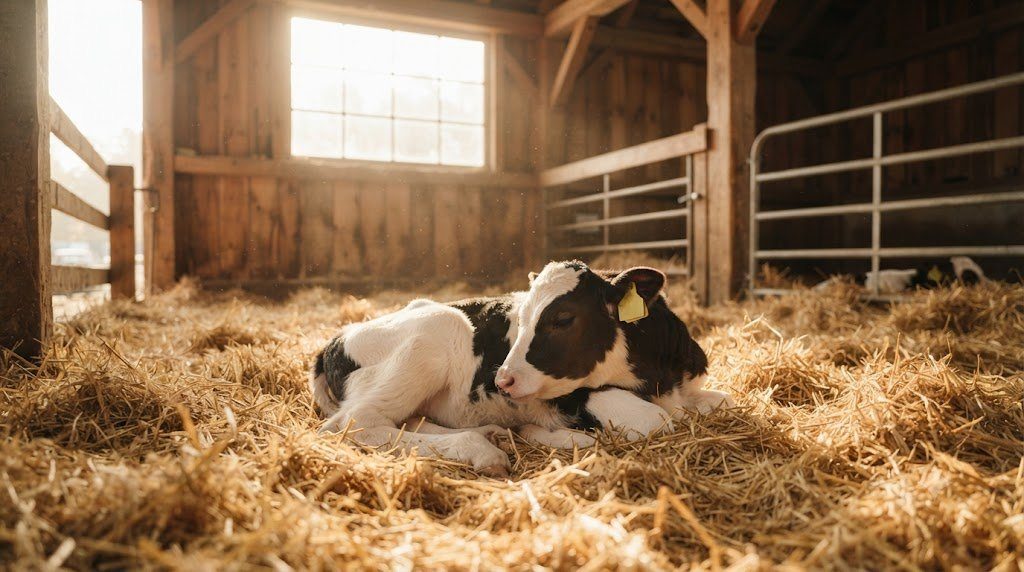
- Establishing strict colostrum management: feeding 4 quarts of high-quality colostrum (>50 g/L IgG) within 2 to 4 hours of birth.
- Navigating dystocia through proper obstetric intervention timing, hygiene, and low-stress extraction mechanics.
- Implementing accelerated calf milk nutrition programs delivering 8 to 10 liters daily of whole milk or 26/20 replacer for early lean tissue development.
- Transitioning calves smoothly through step-down weaning to ensure robust ruminal papillae development on high-starch calf starter.
- Meeting reproductive benchmarks: breeding replacement heifers at 13 to 14 months at 55% of mature body weight to achieve calving at 22 to 24 months.
1. Maternity Pen Management and Obstetric Intervention Protocols
The calving event dictates the survival of the neonate and the subsequent reproductive and lactating capability of the dam. Maternity facilities must prioritize exceptional sanitation, comfort, and low-stress animal movement. Maternity pens should provide at least 140 to 180 square feet of deep-bedded space per cow, utilizing clean wheat straw or kiln-dried wood shavings over non-slip grooved concrete or well-drained clay bases.
Normal bovine parturition proceeds through three distinct stages. Stage 1 (cervical dilation) lasts 2 to 6 hours, characterized by restlessness, tail twitching, and isolation. Stage 2 (fetal expulsion) begins with the appearance of the chorioallantoic membrane (water bag) or fetal feet. In mature cows, delivery should occur within 30 to 60 minutes of active straining; in first-calf heifers, progress should occur within 60 to 90 minutes.
Premature or aggressive obstetric intervention causes severe vaginal lacerations, uterine tears, and obturator nerve paralysis. However, intervention is mandatory if no progress occurs after 30 minutes of active abdominal straining, if only one foot or the head alone presents, or if the fetal tongue appears swollen and cyanotic (purple).
Low-Stress Mechanical Extraction and Delivery Hygiene
Prior to internal examination, the operator must scrub the cow’s perineum, vulva, and tailhead with warm water and chlorhexidine or iodine scrub. Using sterile obstetrical sleeves and non-spermicidal obstetrical lubricant, verify cervical dilation and fetal presentation, position, and posture (normal: anterior, longitudinal, dorsosacral presentation with extended forelimbs).
When applying obstetrical chains, attach one loop above the fetlock joint and place a half-hitch below the dewclaw to distribute mechanical tension across two bone anchor points, preventing cannon bone fractures. Traction must be applied synchronously with the dam’s natural contractions, pulling straight back until the head and shoulders clear the vulva, then angling traction downward toward the cow’s hocks to facilitate pelvic passage.
If stage 2 labor extends beyond 2 hours without progress, assume mechanical dystocia or uterine torsion. Call a veterinary professional immediately rather than forcing extraction, which risks fatal uterine rupture.
2. Neonatal Resuscitation and Critical First-Hour Care
Immediately upon delivery, the newborn calf must establish spontaneous respiration. Clear mucous from the oral and nasal cavities using a bulb syringe or clean gloved finger. Stimulate respiration by vigorously rubbing the calf’s chest with clean dry straw and splashing cold water into the ear canal or across the philtrum to trigger the gasping reflex.
Never suspend calves upside down by their hind legs over a gate or fence. While fluid may drain from the mouth, this fluid originates from the stomach; inverted suspension forces heavy abdominal viscera against the diaphragm, severely compressing the thoracic cavity and compromising lung expansion.
Dip the umbilical cord immediately in a 7% tincture of iodine solution (or 2% chlorhexidine), ensuring the solution reaches the abdominal wall junction. Repeat dipping at 12 and 24 hours. This practice desicates the umbilical vessels and prevents systemic invasion of environmental pathogens (Escherichia coli, Trueperella pyogenes) that cause navel ill, septic arthritis (joint ill), and fatal peritonitis.
3. The Golden Rule of Colostrum: Quality, Quantity, Quickness, and Cleanliness
Bovine placenta is synepitheliochorial, which entirely prevents the transplacental transfer of maternal immunoglobulins to the fetus during gestation. Consequently, calves are born agammaglobulinemic (without active circulating antibodies) and rely 100% on passive transfer of immunity through maternal colostrum.
The intestinal enterocytes of the calf possess non-specific macromolecular permeability for only a brief physiological window. At birth, enterocyte uptake of immunoglobulin G (IgG) is maximum; by 6 hours postpartum, absorption declines by 50%; and by 24 hours, the gut closure occurs, ending antibody absorption.
Successful passive transfer demands adherence to the Four Qs: Quality, Quantity, Quickness, and Cleanliness. Feed a minimum of 4 quarts (3.8 liters) of clean, high-quality colostrum within the first 2 to 4 hours of life, followed by a second 2-quart feeding 6 to 8 hours later. If the calf fails to nurse vigorously from a nipple bottle, administer colostrum using a sanitized esophageal tube feeder.
Evaluating Colostrum Quality and Passive Transfer Benchmarks
Evaluate all maternal colostrum prior to feeding using an optical or digital Brix refractometer. High-quality colostrum registers 22% or higher on the Brix scale, correlating to >50 grams of IgG per liter. Colostrum reading below 22% should be discarded or reserved for older calves after gut closure.
Verify herd passive transfer success by evaluating serum total protein (STP) via clinical refractometer on blood samples drawn from healthy calves aged 24 hours to 7 days. Successful passive transfer benchmarks require >80% of calves to achieve STP ≥ 5.5 g/dL (corresponding to serum IgG ≥ 10 g/L), with elite herds achieving >6.0 g/dL.
4. Accelerated Calf Nutrition and Rumen Development
Traditional calf feeding programs restricted liquid milk to 4 quarts per day to encourage early grain consumption. However, modern physiological research demonstrates that restricted feeding stunts immune competency and permanently reduces mature lactation potential.
Accelerated liquid feeding programs provide 8 to 10 liters daily of pasteurized whole milk or premium 26% protein / 20% fat milk replacer, divided across two or three feedings. Calves reared under accelerated nutrition achieve pre-weaning weight gains of 1.8 to 2.2 pounds per day, doubling their birth weight by 56 days of age.
Rumen development requires microbial fermentation of starchy grains rather than forage. Fermentation of calf starter grain produces butyric and propionic acids, which stimulate the growth and vascularization of ruminal papillae. Provide fresh, textured calf starter grain (minimum 20% to 22% crude protein) and free-choice clean water starting on day 3 of life. Delay coarse hay feeding until post-weaning to ensure calves consume sufficient starter grain.
5. Heifer Rearing Benchmarks: Weaning to First Calving
Replacement heifer rearing represents the second largest operating cost on commercial cattle farms, requiring substantial capital investment before yielding any financial return. Managing heifers to hit precise developmental milestones ensures timely breeding and maximizes lifetime productivity.
Heifers should be bred at 13 to 14 months of age to achieve first calving at 22 to 24 months. Breeding eligibility must be evaluated based on physiological body weight rather than calendar age alone. Heifers should reach 55% of their mature herd body weight at breeding (approx. 750 to 825 lbs for Holsteins; 500 to 575 lbs for Jerseys) and achieve a minimum wither height of 48 to 50 inches.
Post-calving, first-calf heifers should enter the milking string at 82% to 85% of mature body weight (approx. 1,200 to 1,250 lbs for Holsteins). Underfeeding heifers delays puberty and first calving, adding $2.50 to $3.50 per day in non-productive maintenance costs. Conversely, overfeeding prepubertal heifers (ADG > 2.2 lbs/day between 3 and 9 months) results in adipose fat infiltration into the mammary parenchyma, permanently reducing lifetime milk secretory tissue.
6. Weaning Transition Architecture and Group Socialization
The transition from individual housing (hutches or individual indoor pens) to group socialization represents a vulnerable immunological and nutritional junction. Abrupt weaning causes severe distress, elevating serum cortisol, depressing cellular immunity, and triggering post-weaning respiratory disease complexes.
Implement a step-down weaning protocol spanning 10 to 14 days, beginning around day 45 to 50 of life. Reduce liquid milk allocation by 50% for one week (feeding once daily instead of twice), which encourages the calf to aggressively increase dry starter grain intake. A calf is biologically ready for complete weaning only when it consistently consumes at least 2.0 to 2.5 pounds of starter grain daily for three consecutive days.
When moving calves into group pens, limit group sizes to 6 to 8 calves of identical size and age for the first 30 days. Maintain identical starter grain formulations during this transition, ensuring continuous access to fresh clean water and clean straw bedding. Provide a coccidiostat (decoquinate, lasalocid, or monensin) within the starter ration to prevent clinical coccidiosis caused by Eimeria bovis and Eimeria zuernii during the stress of social mixing.
7. Reproductive Synchronization and Estrus Management in Maiden Heifers
Achieving high first-service conception rates in replacement heifers is fundamental to maintaining a tight 12-to-13-month calving interval across the entire herd. While maiden heifers naturally possess higher fertility than lactating cows (conception rates frequently reach 60% to 70%), visual heat detection requires substantial labor and vigilance.
Implementing timed artificial insemination (TAI) protocols standardizes breeding management. A 5-day or 7-day CIDR (Controlled Internal Drug Release) progesterone insert combined with gonadotropin-releasing hormone (GnRH) and prostaglandin F2-alpha (PGF) ensures synchronized ovulation across the entire heifer group, allowing 100% of eligible heifers to be inseminated on a pre-planned schedule.
Producers should aggressively utilize sexed semen on maiden heifers. Since heifers have superior conception rates compared to multiparous cows, utilizing sex-sorted semen (which guarantees 90% female calves) maximizes genetic gain from elite maternal lines while virtually eliminating dystocia associated with large male bull calves. This strategic genetic investment produces high-indexing, valuable replacement stock that secures the future productive base of the enterprise.
Replacement Heifer Growth and Reproductive Target Benchmarks
The following milestone matrix details target ages, body weights, wither heights, and nutritional requirements for replacement heifer rearing:
Frequently Asked Questions: Practical Livestock Management
❓ How can I tell if a calf has suffered failure of passive transfer (FPT)?
Failure of passive transfer can be diagnosed between 24 hours and 7 days of age using a clinical serum refractometer. Blood serum total protein below 5.2 g/dL indicates severe FPT, while 5.2 to 5.4 g/dL indicates marginal transfer. Calves with FPT have a 4-fold higher risk of mortality and severe scours.
❓ When is the best time to disbud (dehorn) dairy and beef calves?
Calves should be disbudded between 1 and 4 weeks of age before the horn bud attaches to the frontal bone of the skull. Utilize a heated cautery iron combined with local anesthesia (cornual nerve block using 2% lidocaine) and a non-steroidal anti-inflammatory drug (meloxicam) for low-stress pain management.
❓ What is the primary cause of neonatal calf scours, and how should it be managed?
Neonatal scours is caused by viral pathogens (rotavirus, coronavirus), protozoa (Cryptosporidium parvum), and bacteria (E. coli, Salmonella). The primary cause of death is dehydration and metabolic acidosis. Treat immediately with oral electrolyte solutions containing sodium, potassium, and glycine, while maintaining milk feeding to provide necessary energy.
❓ What breeding criteria should be prioritized when selecting sires for maiden heifers?
Select sires with high Calving Ease Direct (CED > 10 in beef; SCE < 2.0% in dairy) and low Birth Weight EPDs. Utilizing proven calving ease sires eliminates dystocia risk, preserves heifer pelvic integrity, and ensures rapid uterine involution.
Summary: Comprehensive Implementation Protocols
To successfully integrate these management practices, livestock producers must balance biological animal needs with physical infrastructure and strict financial accountability. Routine observation, objective record-keeping, and preventative herd health protocols yield sustained enterprise longevity, reduced veterinary interventions, and consistent farm profitability across seasonal cycles.