- Analyzing top dairy goat breeds: Swiss heavy-yielders (Saanen, Alpine) vs high-butterfat heritage breeds (Nubian, Nigerian Dwarf).
- Formulating precision dairy rations delivering high-solids milk for artisan farmstead cheesemaking.
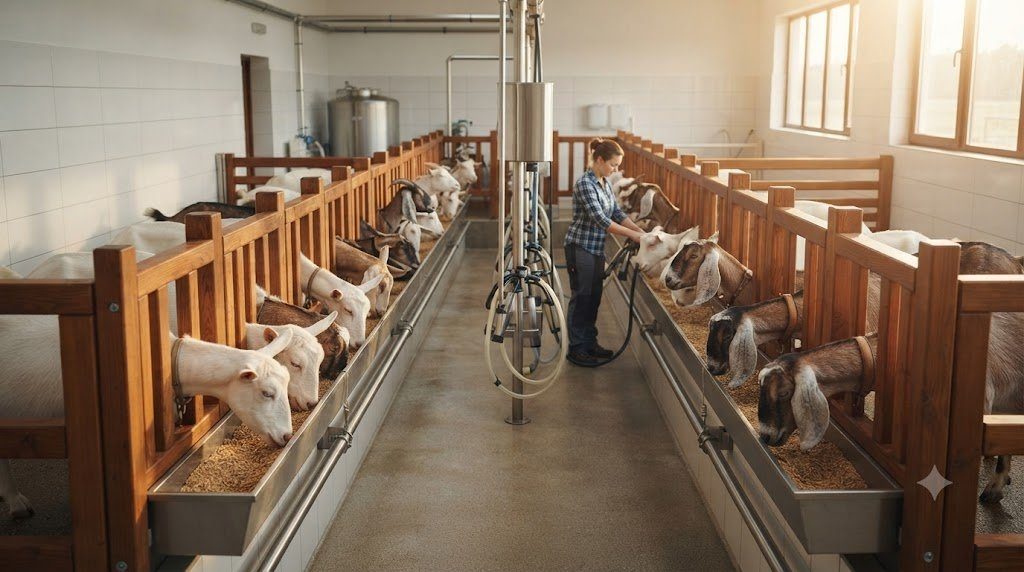
- Designing hygienic milking parlors: elevated stanchions, rapid teat pre-dipping, and cold-chain chilling below 40°F.
- Controlling subclinical caprine mastitis through somatic cell count monitoring and California Mastitis Testing (CMT).
- Managing dry periods, selective dry therapy, and transition nutrition to prevent hypocalcemia and pregnancy toxemia.
1. Dairy Goat Genetics: Swiss Breeds vs. High-Solids Artisan Producers
Commercial dairy goat farming has transitioned from a niche homestead pursuit into a highly sophisticated agricultural sector. Caprine milk offers superior human digestibility due to smaller fat globule diameter (averaging 3.5 microns compared to 4.5 microns in bovine milk) and a higher proportion of short- and medium-chain fatty acids (caproic, caprylic, and capric acids). Furthermore, the predominance of A2 beta-casein and minimal alpha-s1-casein makes goat milk hypoallergenic for many lactose-sensitive consumers.
Choosing dairy goat genetics requires evaluating fluid milk volumetric yield versus total milk solids (butterfat and protein) necessary for artisan cheesemaking (chèvre, feta, gouda, and aged tomme).
The Saanen—originating in the Swiss Alps—is universally recognized as the Holstein of the goat world. These large, docile, all-white or cream-colored does consistently produce staggering volumetric yields, averaging 2,500 to 3,500 pounds of milk across a 305-day lactation, with elite does exceeding 4,000 pounds. While milk butterfat (3.2% to 3.6%) and protein (2.8% to 3.1%) are moderate, their sheer volume makes Saanens ideal for commercial fluid bottling and high-volume fresh cheese operations.
The French Alpine and Anglo-Nubian Profiles
The French Alpine is an alert, medium-to-large breed characterized by diverse color patterns (cou blanc, sundgau), upright ears, and exceptional lactation persistence. Alpines yield 2,300 to 3,000 pounds of milk with slightly higher solids (3.5% fat, 3.2% protein) and excel in automated commercial milking parlor environments.
In contrast, the Anglo-Nubian—distinguished by long drooping ears and a convex Roman profile—originates from crosses of British dairy does with African and Indian desert bucks. Nubians produce lower volumetric yields (1,800 to 2,400 lbs) but deliver rich, concentrated milk containing 4.8% to 5.5% butterfat and 3.8% protein. Their high solids concentration yields 12% to 15% more cheese per gallon of milk than Swiss breeds, while their exceptional heat tolerance makes them premier producers in warm, humid climates.
Crossbreeding Saanen does with high-indexing Nubian bucks produces F1 dairy does delivering 2,600+ lbs of milk with 4.2% butterfat. This cross provides the ideal balance of volumetric fluid yield and high curd yield for farmstead cheesemaking.
2. Caprine Lactation Physiology and Milking Protocols
A dairy goat’s lactation cycle spans 280 to 305 days, peaking between weeks 5 and 8 postpartum before gradually declining at a normal persistence rate of 6% to 9% per month. Managing this lactation curve requires strict parlor routines and prompt milking hygiene.
Milking should occur on a rigid 12-hour schedule (e.g., 6:00 AM and 6:00 PM). Does should be milked in elevated stanchions (18 to 24 inches above handler floor level) equipped with headgates that dispense a small concentrate ration during milking. This positive reinforcement ensures calm, voluntary animal movement into the parlor.
Proper udder preparation is mandatory to trigger the neuroendocrine milk ejection reflex (oxytocin release) and prevent microbial contamination. Strip the first 2 to 3 streams of foremilk from each teat into a strip cup to examine for abnormal flakes, clots, or watery secretions indicative of clinical mastitis. Apply an approved rapid-acting germicidal pre-dip (0.5% iodine or hydrogen peroxide), allow 30 seconds of contact time, and dry each teat thoroughly with an individual clean paper towel or sanitized microfiber cloth.
3. Milking Equipment Engineering and Vacuum Dynamics
Milking goats using mechanized bucket milkers or piped pipeline systems requires caprine-specific vacuum parameters. Milking machines engineered for cattle will cause severe teat end hyperkeratosis, tissue congestion, and irreversible sphincter damage if used on goats.
Caprine vacuum levels must be maintained between 11.0 and 12.0 inches of mercury (inHg) at the claw. The pulsator rate must operate at 90 to 100 pulses per minute—substantially faster than bovine systems (which run at 60 ppm)—with a pulsation ratio of 60:40 or 50:50. The faster pulsation rate matches the natural suckling frequency of goat kids and ensures rapid milk evacuation.
Milking claws must feature lightweight silicone or rubber inflations sized specifically for caprine teats. Automated take-offs (ATOs) should be calibrated to detach claws when milk flow drops below 0.3 pounds per minute. Overmilking on empty teats creates high vacuum exposure to internal teat lining, precipitating tissue edema and inviting opportunistic mastitis pathogens (Staphylococcus aureus, coagulase-negative staphylococci).
4. Milk Chilling, Cold-Chain Sanitation, and Off-Flavor Prevention
Goat milk is naturally homogenized and possesses a delicate lipid profile susceptible to rapid chemical and biological degradation. The notorious ‘goaty’ or musky off-flavor often associated with goat milk is not a natural characteristic of clean milk; it is the direct result of poor hygiene, improper handling, or buck odor contamination.
To preserve sweet, clean flavor, warm milk straight from the goat (approx. 101°F) must be rapidly chilled to below 40°F (4°C) within 45 minutes of harvest. Utilize stainless steel bulk cooling tanks with rapid mechanical agitators, or pass milk through an in-line plate chiller using chilled glycol. Rapid cooling halts the activity of natural lipolytic enzymes that hydrolyze milk fat into free volatile fatty acids (capric and caprylic acids).
Furthermore, mature breeding bucks must be housed in a separate facility located completely downwind from the milking parlor and milk room. Bucks secrete intense musky sebaceous oils from scent glands located adjacent to their horns and in their urine during the rut; ambient buck scent particles are readily absorbed by the warm fat molecules in freshly harvested milk.
5. Caprine Mastitis Management and Somatic Cell Count (SCC) Interpretation
Mastitis management in dairy goats requires specialized clinical knowledge because caprine milk secretion differs biologically from bovine secretion. Cattle exhibit merocrine milk secretion, where milk components are secreted without cell cytoplasm. Goats exhibit apocrine milk secretion, in which non-cellular cytoplasmic droplets shed naturally into the milk.
Because automated electronic somatic cell counters often count these benign cytoplasmic particles as somatic cells, the baseline Somatic Cell Count (SCC) in completely healthy, uninfected dairy goats naturally ranges between 500,000 and 1,000,000 cells/mL. An SCC that would indicate severe clinical mastitis in a cow (e.g., 800,000 cells/mL) is entirely normal and uninfected in a lactating doe, particularly during late lactation.
Routine herd monitoring requires using the California Mastitis Test (CMT) weekly. The CMT reagent reacts with DNA from white blood cells (neutrophils), forming a viscous gel that reflects actual inflammation rather than harmless cytoplasmic droplets. Any doe showing a 2+ or 3+ CMT reaction should undergo aseptic milk collection for laboratory bacterial culturing to identify causative organisms (Staphylococcus aureus, Mycoplasma agalactiae, Streptococcus uberis).
6. High-Lactation Nutritional Formulations and Ration Balancing
A high-yielding 140-pound dairy doe producing 10 to 12 pounds of milk daily requires immense nutritional density. Due to their small rumen volume relative to metabolic body weight, high-producing does cannot fulfill energy demands on pasture alone.
The lactation ration must balance premium-quality, leafy legume hay (second or third-cutting alfalfa delivering 18% to 22% crude protein) with a balanced concentrate grain mix (16% CP) fed at a rate of 1 pound of grain for every 3 pounds of milk produced, plus 1 pound for maintenance. Grains should feature rolled barley, oats, beet pulp, and bypass protein meals.
To prevent enterotoxemia and subclinical ruminal acidosis, grain meals should be split across morning and evening milkings rather than fed as a single large bolus. Free-choice clean, warm water (warmed to 50°-60°F in winter) is mandatory; a dairy doe consumes 3 to 5 gallons of water per day, and water restriction for even 4 hours causes an immediate 15% drop in milk yield.
7. Dry Period Management and Caprine Arthritis Encephalitis (CAE) Eradication
Dairy does require a mandatory 60-day dry period prior to kidding to allow mammary tissue involution, epithelial regeneration, and replenishment of body mineral reserves. Cease milking abruptly 60 days before the projected kidding date, while transitioning does to a grass-hay diet for 5 days to reduce milk synthesis.
Administer selective dry doe antibiotic therapy (or non-antibiotic bismuth subnitrate internal teat sealants) to does with a history of elevated CMT scores. Dry doe therapy eliminates subclinical intramammary infections and provides persistent protection against new environmental infections during the dry period.
Biosecurity must aggressively target Caprine Arthritis Encephalitis (CAE), a lentivirus that causes chronic interstitial mastitis (‘hard udder’), severe polyarthritis, and progressive wasting. CAE is primarily transmitted from infected does to newborn kids via contaminated colostrum and raw milk. Establish a closed, CAE-free herd by testing all adults annually via ELISA serology, immediately removing reactor does, and rearing all newborn kids on heat-treated colostrum (133°F for 60 minutes) and pasteurized milk.
8. Farmstead Creamery Economics: Fluid Bottling vs. Artisan Cheesemaking
Commercial dairy goat operations capture superior profit margins through value-added on-farm processing rather than selling raw fluid milk to wholesale aggregators. Wholesale raw goat milk typically commands $35 to $50 per hundredweight ($3.00 to $4.30 per gallon), yielding narrow margins after factoring in high labor overhead.
In contrast, transforming goat milk into farmstead artisan cheese delivers extraordinary returns. One gallon of high-solids goat milk yields approximately 1.0 to 1.3 pounds of fresh chèvre or 0.85 to 1.0 pound of aged hard cheese. Retailing artisan chèvre at $18 to $26 per pound generates gross revenue equivalent to $18 to $28 per gallon of milk harvested.
Enterprise budgeting must account for capital expenditures in Grade-A milk house equipment: pasteurizers, cheese vats, aging caves, and certified sanitary drainage. Maintaining a herd of 30 to 50 milking does with high solids genetics and direct-marketing artisan cheese to farmers markets, specialty culinary shops, and restaurants establishes a highly lucrative, sustainable farm business.
Dairy Goat Breed Production Matrix and Milk Composition Comparison
The following comparative benchmarks contrast mature weights, lactation yields, and milk solids across primary commercial dairy goat breeds:
Frequently Asked Questions: Practical Livestock Management
❓ Why does commercial goat milk have a naturally high Somatic Cell Count (SCC)?
Unlike cows (which secrete milk via merocrine secretion), goats produce milk through apocrine secretion, which naturally sheds non-cellular cytoplasmic droplets into the milk. Standard electronic cell counters count these harmless particles as somatic cells, making normal uninfected goat milk register 500,000 to 1,000,000 SCC.
❓ What causes the strong ‘goaty’ flavor in goat milk, and how can it be eliminated?
Goaty off-flavors are caused by volatile free fatty acids released when warm milk is cooled too slowly, or when milk absorbs airborne scent compounds from rutting bucks. Prevent off-flavors by chilling harvested milk to under 40°F within 45 minutes and housing all bucks completely downwind from the milking barn.
❓ How can I prevent pregnancy toxemia (ketosis) in dairy does carrying triplets?
Pregnancy toxemia occurs in late gestation when rapid fetal growth compresses rumen capacity while energy demands surge. Prevent toxemia by providing energy-dense rations (high-quality alfalfa hay plus 1.0 to 1.5 lbs of 16% dairy grain daily) during the final 4 weeks, avoiding overconditioning in early pregnancy (target BCS 3.25).
❓ What is the proper pasteurization temperature for caprine milk?
Batch (vat) pasteurization requires heating milk to a minimum of 145°F (63°C) and holding it continuously for 30 minutes, followed by rapid cooling. High-Temperature Short-Time (HTST) continuous pasteurization requires 161°F (72°C) for 15 seconds.
Summary: Comprehensive Implementation Protocols
To successfully integrate these management practices, livestock producers must balance biological animal needs with physical infrastructure and strict financial accountability. Routine observation, objective record-keeping, and preventative herd health protocols yield sustained enterprise longevity, reduced veterinary interventions, and consistent farm profitability across seasonal cycles.