- Designing robust, fail-safe livestock watering systems: gravity-fed pipelines, solar direct pumping, and frost-free subterranean networks.
- Installing frost-proof sanitary yard hydrants with proper pea gravel drainage beds to eliminate winter freezing.
- Selecting and constructing heavy-duty perimeter boundary fencing: 5-to-6 strand high-tensile electric and woven wire field fence.
- Engineering corner H-brace assemblies and driven line post foundations to withstand decades of tension and ground shifting.
- Integrating quick-coupling pasture water valves and portable float-troughs to facilitate effortless daily rotational paddock shifts.
1. The Foundational Infrastructure of Livestock Farming: Water and Containment
When developing or expanding a small commercial livestock farm, physical infrastructure represents the largest upfront capital investment. While livestock genetics, pasture seeding, and machinery often dominate farmer conversations, the unglamorous reality of animal agriculture is that fencing and water dictate 90% of daily operational efficiency.
Inadequate fencing turns livestock management into a chronic nightmare of highway liability, neighbor disputes, destroyed garden crops, and predator carnage. Similarly, a poorly designed watering system forces farmers to spend hours hauling heavy hoses, breaking ice with sledgehammers in sub-zero blizzards, and watching animals dehydrate, precipitating immediate production crashes and acute metabolic illness.
Designing resilient, low-maintenance physical infrastructure requires adhering to proven civil engineering and hydrodynamic principles. Fencing must present both an impenetrable physical barrier and a psychological deterrent, while watering systems must deliver continuous, pressurized, frost-proof hydration to every corner of the grazing landscape with zero manual hauling.
The Daily Water Demand Calculation Across Livestock Classes
A watering system must be engineered to deliver peak daily volume under worst-case heatwave conditions (ambient temperatures > 90°F / 32°C). Never size pipes based on average winter consumption.
Daily peak water requirements are: mature lactating dairy cow (35 to 50 gallons); beef cow-calf pair (18 to 25 gallons); gestating sow (5 to 8 gallons); lactating sow (8 to 12 gallons); finishing market pig (3 to 5 gallons); mature ewe or doe (2.5 to 4 gallons); and 100 pastured broiler chickens (8 to 12 gallons). A diversified small farm carrying 15 beef cattle, 40 hair sheep, 20 meat goats, and 30 pastured pigs requires a reliable water delivery capacity of at least 800 to 1,200 gallons per day.
Never install 1/2-inch pipe for long pasture runs. Friction loss over 500+ feet will drop water flow to a useless trickle. Always install minimum 1.0-inch or 1.25-inch High-Density Polyethylene (HDPE) pipe to maintain high flow rates and support fast float-valve recovery.
2. Subterranean Water Line Engineering: HDPE Pipe, Burial Depth, and Friction Loss
The backbone of a permanent farm watering system is an underground distribution main utilizing High-Density Polyethylene (HDPE) or Polyvinyl Chloride (PVC) pipe.
HDPE pipe (rated at 200 PSI, SDR 9 or 11) is vastly superior to rigid PVC for farm water lines. HDPE is flexible, comes in continuous seamless 500-foot rolls that eliminate subterranean glued joints, expands slightly during freezing without rupturing, and easily withstands heavy tractor and livestock hoof traffic.
Burial depth must penetrate strictly below the local historical maximum frost line (typically 36 to 48 inches in northern temperate climates; 18 to 24 inches in transition zones). Trenching should be executed with a continuous-chain vibratory plow or compact excavator. Backfill trenches carefully, bedding the pipe in 4 inches of clean sand or stone-free loam before backfilling rocky native soil, preventing sharp stones from puncturing the pipe under compaction.
3. Frost-Proof Yard Hydrants and Automatic Geothermal Float Waterers
Delivering pressurized water above ground during freezing winter weather requires installing frost-proof sanitary yard hydrants.
A frost-proof hydrant features a shut-off valve located deep underground at the base of the pipe, below the frost line. When the handle is raised, water flows up the standpipe; when the handle is lowered, the underground valve closes and simultaneously uncovers a small drain port. All water remaining inside the vertical standpipe immediately drains out into a subterranean drain bed, leaving the above-ground pipe completely empty and immune to freezing.
Proper installation is mandatory: excavate a pit 2 feet below the frost line, connect the hydrant using brass or stainless steel fittings, and backfill the base with minimum 4 to 6 cubic feet of washed 3/4-inch pea gravel or crushed stone, covered with a layer of geotextile landscape fabric. The pea gravel pocket provides an open void for water drainage; failing to provide gravel causes mud to plug the drain port, freezing and splitting the hydrant during the first hard freeze.
In permanent winter sacrifice paddocks, install geothermal energy-free livestock waterers (such as Miraco, Richie, or Jug waterers). These heavily insulated polyurethane waterers utilize warm underground geothermal air rising through a 12-inch vertical insulated ground tube to keep drinking water liquid down to -20°F without electric heating elements.
4. Gravity-Fed and Solar-Direct Livestock Pumping Systems
For remote pastures without access to grid electrical power, gravity-fed networks and solar-powered pumping systems provide complete energy independence.
Gravity-Fed Systems: If a farm possesses an elevated spring, upland pond, or hilltop storage tank, gravity provides reliable hydraulic pressure. Every 2.31 feet of vertical elevation drop (head) generates 1.0 PSI of static water pressure. A header tank located on a knoll 70 feet above pasture waterers delivers approximately 30.3 PSI of pressure—ample force to operate high-flow float valves across hundreds of acres without pumps or electricity.
Solar-Direct Pumping: For deep wells or lowland streams, install a DC submersible solar pump (such as SunPumps, Grundfos, or Shurflo) powered directly by photovoltaic (PV) solar panels. The pump operates whenever sunlight strikes the panels, lifting water uphill into a high-elevation 1,500 to 3,000-gallon black poly storage cistern. The storage cistern acts as a biological hydraulic battery; water gravity-feeds down to livestock paddocks 24/7, providing 3 to 5 days of reserve water during overcast weather.
5. Heavy-Duty Perimeter Boundary Fencing: High-Tensile vs. Woven Wire
The external boundary fence is the farm’s primary legal and physical defense line. Cutting corners on perimeter fencing guarantees escaped livestock, destroyed crops, and severe vehicular liability.
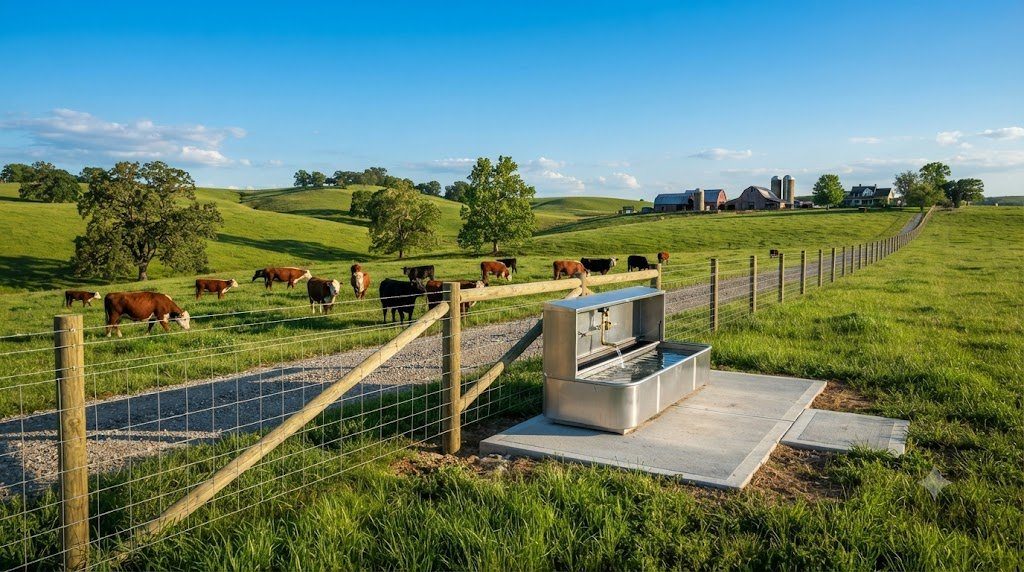
Class 3 Galvanized 48-Inch Woven Wire: The gold standard physical barrier for multi-species containment. Choose a ‘fixed-knot’ or ‘hinge-joint’ fence featuring 12.5-gauge high-tensile wire with 4×4-inch or 6×6-inch mesh spacing. Fixed-knot fences utilize solid vertical stay wires that do not slide under animal pressure, easily withstanding impacts from heavy cattle and charging pigs.
High-Tensile Smooth Steel Electric Fencing: An extraordinarily strong, economical perimeter alternative. Install 5 to 7 strands of 12.5-gauge high-tensile wire (minimum 170,000 to 200,000 PSI tensile strength) energized to 6,000 to 8,000 volts. Alternating positive (hot) and negative (ground-return) wires ensures animals receive a massive electrical shock even during dry summer droughts when soil conductivity is poor.
6. Corner Assembly Engineering: The H-Brace and Floating Diagonal
A fence is only as strong as its corner and end assemblies. When high-tensile wire is tensioned to 200 to 250 pounds of pull per strand, a 6-strand fence exerts over 1,500 pounds of continuous inward tension on corner posts. A single weak post will heave out of the ground within one winter freeze-thaw cycle, causing the entire fence line to sag.
The premier corner structure is the Double H-Brace Assembly:
Install two heavy, pressure-treated wooden posts (minimum 6 to 8-inch diameter, 8 feet long) driven 3.5 to 4.0 feet deep into undisturbed subsoil, spaced exactly 8 feet apart (the length of the horizontal brace post). Connect the posts horizontally at the top with a 4 to 5-inch diameter wooden brace rail. Install a diagonal twitch wire consisting of two complete loops of 12.5-gauge high-tensile wire running from the top of the second post down to the ground level of the corner post. Tension the twitch wire with an in-line wire strainer or wooden twitch stick until the assembly is rigid.
The physics of the H-brace transfers horizontal wire tension down into the base of the corner post, preventing post uplift and maintaining drum-tight wire tension for 30+ years.
7. Quick-Coupling Pasture Valves and Portable Rotational Waterers
To achieve effortless daily rotational grazing without moving permanent infrastructure, install Plasson or Hansen quick-coupling twist-lock water valves along pasture alleyways and fence lines.
Quick-coupling valves are connected to surface or shallow-buried HDPE pipe and installed flush with the ground inside an 8-inch round plastic valve box. The farmer carries a lightweight portable water trough (15 to 30 gallons) equipped with a flexible reinforced hose terminating in a quick-coupling male key. Pushing and twisting the key into the subterranean valve instantly turns on pressurized water flow; uncoupling automatically seals the valve watertight.
Equip portable troughs with high-flow, low-pressure float valves (such as the Jobo or Apex valve) protected beneath a rigid steel or plastic float cover. High-flow valves deliver 5 to 10 gallons per minute, allowing a small 20-gallon trough to successfully hydrate a mob of 40 cattle or 100 sheep because the trough refills as fast as the animals drink.
8. Grounding Systems and Fence Energizer Electronics
Over 85% of electric fencing failures are caused by improper electrical grounding. An electric fence is an incomplete open circuit; when an animal touches the hot wire, electric current pulses through its body into the soil, travels through the ground moisture back to the energizer’s ground rods, and completes the circuit to deliver an intense shock.
If ground rods are corroded, too short, or installed in dry sand, electrical resistance blocks current flow, and the animal feels nothing. Install a minimum of three 6 to 8-foot galvanized steel or copper-clad ground rods spaced at least 10 feet apart, driven completely into moist soil, and connected to the energizer’s ground terminal using a continuous 12.5-gauge insulated underground cable secured with heavy brass ground clamps.
Select low-impedance cyclic wave energizers delivering at least 1.0 joule of stored energy for every 5 miles of fence wire. High-joule energizers easily burn through weeds and brush contacting the lower wires without dropping voltage below the critical 5,000-volt deterrent threshold.
Farm Water and Fencing Engineering Specifications
The following technical benchmark matrix details dimensions, hydraulic flow rates, and material standards for farm infrastructure:
Frequently Asked Questions: Practical Livestock Management
❓ Why did my frost-proof yard hydrant freeze and split during the winter?
Frost-proof hydrants freeze for two primary reasons: first, if a garden hose was left attached to the nozzle, vacuum pressure traps water inside the vertical pipe, preventing it from draining underground; second, if inadequate pea gravel was placed at the base, mud plugs the drain port, trapping water inside the pipe.
❓ What is the difference between low-impedance and high-impedance fence energizers?
Older high-impedance chargers produce a slow, weak pulse that short-circuits as soon as green grass touches the wire. Modern low-impedance energizers deliver ultra-fast, high-amperage microsecond pulses that easily burn through weeds without dropping voltage, maintaining full shock power across miles of fence.
❓ Can I use black plastic poly pipe above ground for summer pasture water?
Yes, surface HDPE or UV-stabilized poly pipe can be laid along fence lines for summer rotational grazing. However, during hot sunny days, water inside surface pipe can heat up to 130°F (54°C). Paint pipes white, place them under fenceline vegetation shade, and purge hot water before livestock drink.
❓ How deep should wooden corner posts be driven into the ground?
Corner and end posts must be driven to a minimum depth of 3.5 to 4.0 feet into undisturbed subsoil. Posts set in hand-dug holes with loose backfill will inevitably heave under high-tensile wire tension; driving posts with a hydraulic post driver ensures maximum soil friction and structural stability.
Summary: Comprehensive Implementation Protocols
To successfully integrate these management practices, livestock producers must balance biological animal needs with physical infrastructure and strict financial accountability. Routine observation, objective record-keeping, and preventative herd health protocols yield sustained enterprise longevity, reduced veterinary interventions, and consistent farm profitability across seasonal cycles.