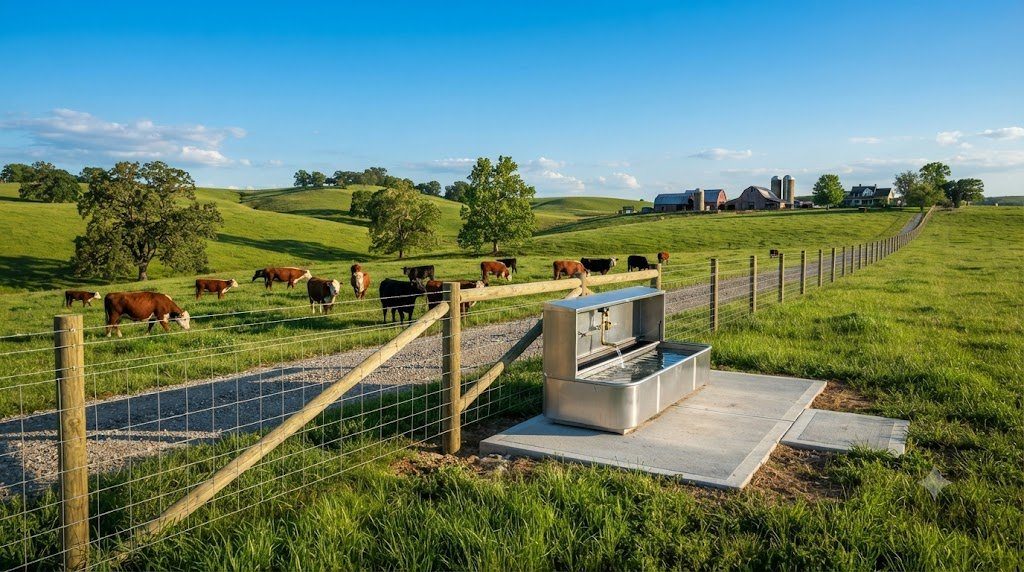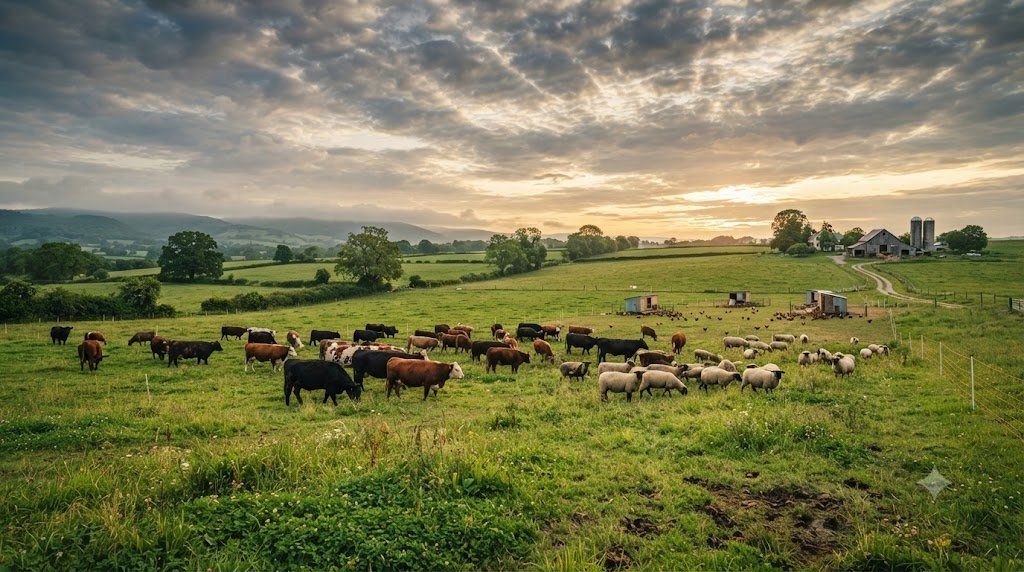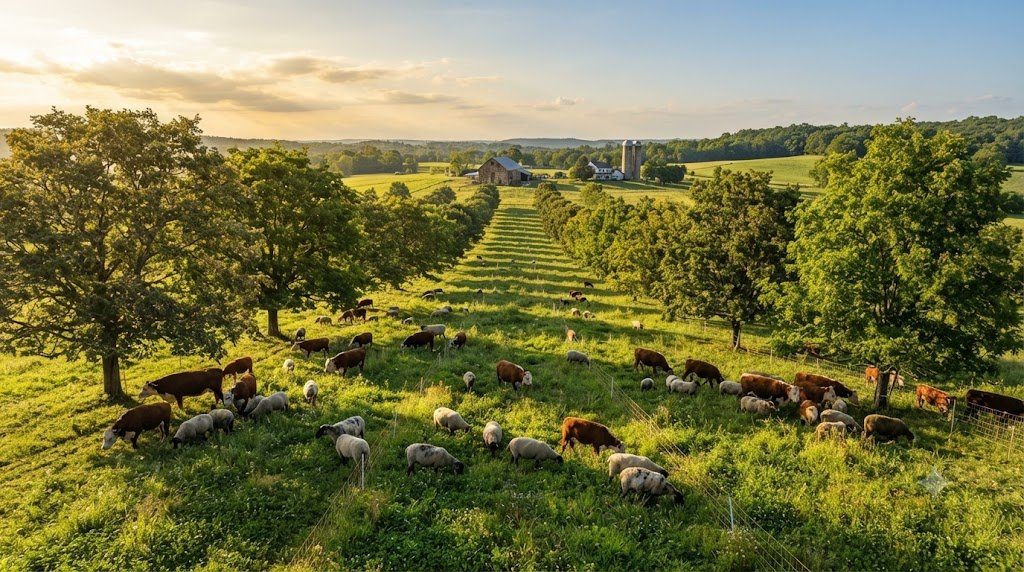
- Integrating the three pillars of silvopasture: intentional planting of trees, forage swards, and managed livestock grazing.
- Selecting high-value multi-purpose tree species: timber hardwoods (black walnut, oak), nitrogen-fixers (black locust), and fodder trees (willow, mulberry).
- Mitigating livestock heat stress through canopy microclimates: lowering ambient temperatures by 8°F to 15°F.
- Harvesting tree leaf tree hay (fodder) for high-protein midsummer drought reserves and natural anthelmintic tannins.
- Designing spatial tree planting layouts (alleys, clusters, savannas) and protecting saplings from livestock bark damage.
1. The Silvopasture Architecture: Ecological Synergy in Three Dimensions
Modern agricultural industrialization created a false dichotomy between forestry and animal husbandry, clearing millions of acres of forest for monoculture pastures while fencing livestock out of poorly managed woodlots. In contrast, Silvopasture is the intentional, intensive, and integrated management of three distinct biological components on a single land footprint: timber and fruit/nut trees, high-value forage swards, and grazing livestock.
Silvopasture is fundamentally differentiated from unmanaged woodland grazing. Simply turning livestock loose into native forest invariably leads to destructive overgrazing of understory vegetation, soil compaction, root damage, and zero economic timber growth. Silvopasture utilizes engineered tree spacing (typically 30 to 50 feet between rows) that allows 40% to 60% of ambient solar radiation to penetrate to the forest floor, stimulating lush perennial forage growth while providing continuous shade canopy.
This three-dimensional agricultural design captures superior biological efficiencies. Deep tree roots extract subsoil water and trace minerals from depths unreachable by shallow pasture grasses, cycling nutrients to the surface via annual leaf fall. Simultaneously, livestock manure fertilizes tree root systems, and managed grazing suppresses invasive brush that would otherwise compete with commercial timber trees.
The Microclimatic Buffering Advantage
Thermal stress severely erodes commercial livestock productivity. When ambient temperatures and humidity push the Temperature-Humidity Index (THI) above critical thresholds (68 for dairy cattle, 72 for beef, 80 for sheep), animals suffer respiratory distress, fertility failure, reduced feed intake, and depressed immune function.
Silvopasture canopies create a profound microclimatic buffer. Mature silvopastoral tree canopies lower understory ground surface temperatures by 8°F to 15°F (4.5°C to 8.3°C) during peak summer heat, while reducing convective wind chilling by 40% to 60% during winter storms. Livestock grazing in silvopastures maintain continuous rumination and dry matter intake during heatwaves that leave open-pasture cattle panting under severe thermal distress.
Target a 40% to 50% tree canopy shade density. Cool-season grasses grown under moderate silvopastoral shade contain higher crude protein, lower structural lignin, and improved digestibility compared to identical grasses grown in full sun.
2. Selecting Elite Silvopastoral Tree Species: Timber, Fodder, and Mast
Selecting tree genetics requires evaluating climate hardiness, growth velocity, timber market value, and nutritional fodder characteristics.
High-Value Hardwood Timber: Species such as Black Walnut (Juglans nigra), Northern Red Oak (Quercus rubra), and Black Cherry (Prunus serotina) deliver extraordinary long-term capital appreciation. Black walnut produces valuable veneer logs worth thousands of dollars per tree at 40-year maturity, while its open, feathery compound leaf canopy naturally filters sunlight, allowing excellent understory grass growth. (Note: Black walnut roots produce juglone, which suppresses certain plants but does not harm orchardgrass, tall fescue, or white clover).
Rapid-Growth Nitrogen-Fixers: Black Locust (Robinia pseudoacacia) is the premier silvopastoral workhorse. A leguminous tree, black locust fixes atmospheric nitrogen (75 to 150 lbs N/acre annually) into the soil, fertilizing surrounding pasture grasses without chemical inputs. Its leaves contain 20% to 24% crude protein and are eagerly browsed by sheep, goats, and cattle. Furthermore, black locust wood is virtually rot-proof, producing indestructible farm fencing posts in only 10 to 12 years.
High-Volume Fodder Trees: Hybrid Willows (Salix spp.) and White Mulberry (Morus alba) produce staggering volumes of leafy biomass. Mulberry leaves deliver 18% to 22% crude protein with an in vitro dry matter digestibility exceeding 80%—superior to top-grade alfalfa hay.
3. Tree Fodder and Leaf Hay: Drought Reserves and Tannin Parasite Defense
Tree fodder (harvesting edible branches and leaves for livestock consumption) is an ancient agricultural practice that provides critical resilience during midsummer droughts when pasture grasses turn brown and dormant.
Unlike shallow-rooted grasses that wither within two weeks of zero rainfall, deep-rooted fodder trees tap into deep subterranean groundwater reserves, producing vibrant green, moisture-rich leafy foliage throughout severe drought conditions. Producers can browse livestock directly through fodder hedge alleys, or cut branches (a practice known as coppicing or pollarding) and drop them directly into grazing paddocks.
Furthermore, tree fodder delivers potent biological anthelmintic benefits. Leaves from willow, oak, and birch contain elevated levels of condensed tannins and salicylic acid. Ingested tannins bind to internal parasite proteins, inhibiting egg hatching and dislodging adult barber pole worms from the abomasal wall, while natural salicylic acid provides anti-inflammatory pain relief.
4. Spatial Design and Layout: Alley Cropping vs. Savanna Configurations
Establishing a silvopasture requires deliberate spatial engineering to accommodate livestock movement, solar angles, and agricultural machinery.
Alley Silvopasture: Trees are planted in straight, parallel single or double rows spaced 40 to 60 feet apart, running strictly north-to-south. North-to-south orientation ensures that morning sunlight strikes the eastern side of the pasture alley and afternoon sun illuminates the western side, providing uniform daily light distribution to understory grasses. The wide alleys allow standard farm tractors, balers, and mowers to operate unhindered.
Savanna Silvopasture: In converted woodlands or rolling terrain, trees are thinned to an irregular, park-like savanna density of 40 to 80 mature trees per acre. Heavy logging machinery removes low-value, diseased, and crooked trees, opening the forest canopy. The forest floor is seeded with shade-tolerant perennial forages (orchardgrass, meadow fescue, subterranean clover) to establish a continuous grazing sod.
5. Protecting Young Saplings from Livestock Damage
The greatest biological vulnerability in establishing silvopastures is preventing livestock from destroying young trees during the first 3 to 7 years of establishment. Grazing animals will rub against trunks, chew bark, strip terminal buds, and trample tender saplings.
Physical Tree Guards: For single-tree plantings, install heavy-duty 5-foot rigid mesh wire cages supported by two driven steel T-posts. Avoid lightweight plastic tree tubes in livestock pastures; cattle will use plastic tubes as scratching posts, crushing them into the ground.
Temporary Electric Exclusion: In alley silvopasture designs, the most cost-effective protection is running temporary electrified polywire fences on both sides of the tree rows. Keep livestock confined to the central pasture alley for the first 4 to 5 years until tree trunks achieve a caliper diameter of at least 4 inches and the lower branches have grown above the reach of browsing livestock.
6. Forage Sward Selection for Shade Tolerance and Resilience
Not all pasture grasses and legumes adapt successfully to shaded silvopastoral environments. Full-sun warm-season grasses (such as Bermuda grass and switchgrass) languish under tree canopies and die out within two seasons.
Silvopastures require shade-adapted cool-season perennials that maintain active photosynthetic rates under filtered solar irradiance. The premier silvopastoral grass is Orchardgrass (Dactylis glomerata), which thrives under 30% to 50% shade, producing tender, high-protein vegetative leaf blades. Other exceptional companion grasses include Meadow Fescue (Festuca pratensis), Kentucky Bluegrass, and Creeping Red Fescue.
For nitrogen-fixing legumes, White Clover (Trifolium repens) and Subterranean Clover are the premier choices. White clover spreads via underground stolons, forming dense ground cover beneath tree canopies that fixes 80 to 120 pounds of organic nitrogen per acre while tolerating close grazing by sheep and cattle.
7. Carbon Sequestration and Environmental Hydrology
Project Drawdown ranks silvopasture as one of the top ten most powerful natural climate solutions in the world, far surpassing standard pasture grazing and open-field agriculture in carbon sequestration potential.
While open pastures store carbon primarily in the top 12 inches of soil (which can be rapidly re-emitted during severe droughts or tillage), silvopastures store carbon simultaneously in four distinct reservoirs: the deep root systems of perennial grasses, long-term microbial soil humus, deep tree taproots, and massive above-ground standing timber wood biomass. Studies document silvopastures sequestering 2.0 to 5.0 metric tons of carbon equivalent per acre annually.
Furthermore, silvopastures dramatically improve farm hydrology. Deep tree roots act as vertical conduits, opening subterranean channels that increase water infiltration rates by 300% compared to open pastures, virtually eliminating surface soil erosion, preventing flash flooding, and recharging underground aquifers.
8. Long-Term Enterprise Economics: Multi-Tiered Revenue Stacking
The overarching economic brilliance of silvopasture lies in stacking short-, medium-, and long-term financial returns on a single acre of land.
Short-Term Returns (Annual): Livestock grazing generates reliable, annual cash flow through market lambs, beef cattle, pastured pork, or dairy sales.
Medium-Term Returns (3 to 10 Years): Thinning black locust trees yields high-value rot-proof fence posts ($15 to $25 per post) and premium cordwood firewood, while fruit and nut trees (chestnuts, walnuts) begin annual commercial nut production.
Long-Term Returns (25 to 40 Years): Mature hardwood timber harvest yields massive capital lump sums. A well-managed silvopasture containing 40 mature black walnut or white oak trees per acre can yield $40,000 to $80,000 per acre in timber value upon final harvest, serving as a self-funding retirement pension for the farm family.
9. Practical Implementation Roadmap: Phased Transition to Silvopasture
Transitioning an open pasture or neglected woodlot into a fully functional, highly productive silvopasture requires a disciplined multi-year implementation plan to avoid common operational pitfalls.
In Year 1, conduct thorough baseline soil testing (evaluating pH, organic matter, and macronutrient reserves) and map natural topographic contour lines using laser levels or GPS mapping. Establish permanent perimeter fencing and install underground water distribution mains before planting trees. In autumn, plant bare-root timber and fodder saplings along pre-marked contour alleys, installing rigid 5-foot wire mesh tree guards around each sapling.
In Years 2 through 4, manage pasture alleys through flash-grazing with sheep or mechanical mowing, strictly excluding heavy cattle until tree root systems achieve structural anchor strength. Prune lower side branches annually during dormant winter months to maintain clean, knot-free central sawlogs up to 10 to 16 feet high. By Year 5, trees have developed resilient bark and canopy clearance, allowing full integration of mixed cattle, sheep, and swine herds, establishing a magnificent, self-sustaining three-dimensional agricultural ecosystem.
Silvopasture Tree Species Classification and Economic Profile
The following performance matrix contrasts growth rates, shade characteristics, fodder value, and timber harvest timelines across leading silvopastoral tree species:
Frequently Asked Questions: Practical Livestock Management
❓ Will black walnut trees poison livestock grazing beneath them due to juglone?
No. While black walnut roots secrete juglone (which inhibits sensitive solanaceous plants like tomatoes and alfalfa), common cool-season pasture grasses (orchardgrass, Kentucky bluegrass, tall fescue) and white clover are completely immune to juglone and grow vigorously beneath walnut canopies.
❓ How can I convert existing dense woodland into productive silvopasture?
Thin the forest systematically to a 40% to 50% canopy density by removing crooked, diseased, and undesirable understory trees. Use forestry mulchers to grind brush into woodchips on the forest floor, apply lime to correct soil acidity, and broadcast shade-tolerant orchardgrass and white clover seeds prior to autumn rains.
❓ How many trees per acre should be planted in a new silvopasture system?
Plant initial tree alleys at a density of 150 to 300 saplings per acre (e.g., rows 40 feet apart with trees spaced 10 feet apart within rows). As trees mature, systematically thin the rows at years 10 and 20 to achieve a final mature density of 40 to 60 elite timber trees per acre.
❓ Can sheep and cattle be grazed together in a young silvopasture?
Yes, provided trees are protected by rigid physical wire cages or temporary electric fencing. Sheep are particularly well-suited for silvopasture because they graze grass and weeds close to tree trunks without the heavy rubbing impact of 1,500-pound cattle.
Summary: Comprehensive Implementation Protocols
To successfully integrate these management practices, livestock producers must balance biological animal needs with physical infrastructure and strict financial accountability. Routine observation, objective record-keeping, and preventative herd health protocols yield sustained enterprise longevity, reduced veterinary interventions, and consistent farm profitability across seasonal cycles.