- Harnessing the ecological stacking principle: exploiting distinct grazing heights, dietary preferences, and manure biology.
- Executing the leader-follower rotation sequence: cattle first for tall grass, sheep for forbs, goats for brush, and poultry for sanitization.
- Achieving biological parasite suppression: non-host cross-species ingestion destroys livestock-specific nematode larvae.
- Accelerating soil organic matter (SOM) formation through diverse trampling dynamics and multi-species manure microbiology.
- Formulating whole-farm stocking calculations and seasonal forage allocation across diverse small ruminant and bovine herds.
1. The Ecological Stacking Principle: Dietary Niches and Pasture Morphology
In natural grassland biomes—from the African Serengeti to the historic North American Great Plains—herbivores never grazed in single-species monocultures. Instead, vast multi-species assemblages moved synchronously across the landscape: megaherbivores harvested coarse, fibrous grasses, followed by intermediate grazers harvesting vegetative regrowth, followed by ground-foraging birds that scratched through manure deposits for insect larvae.
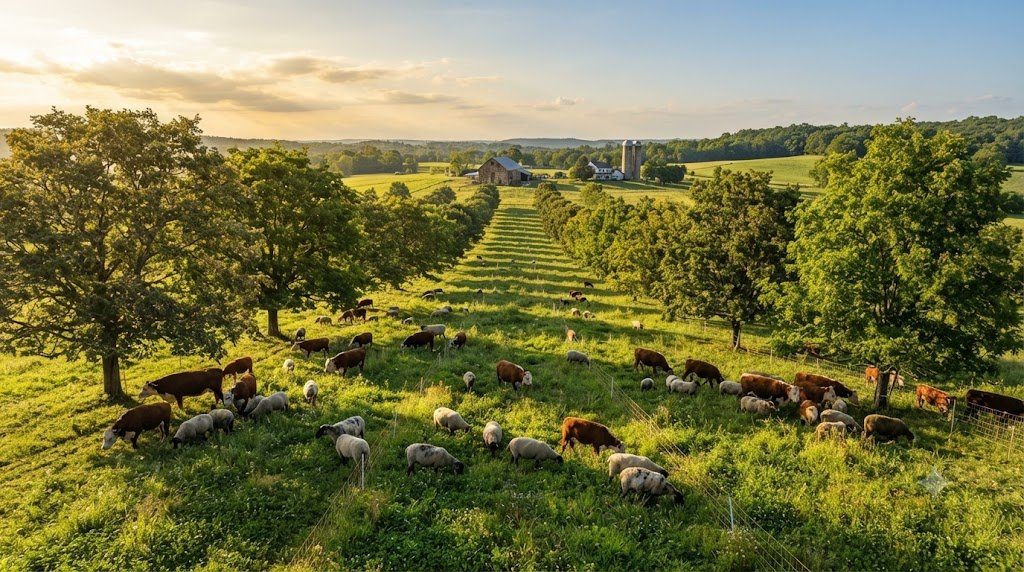
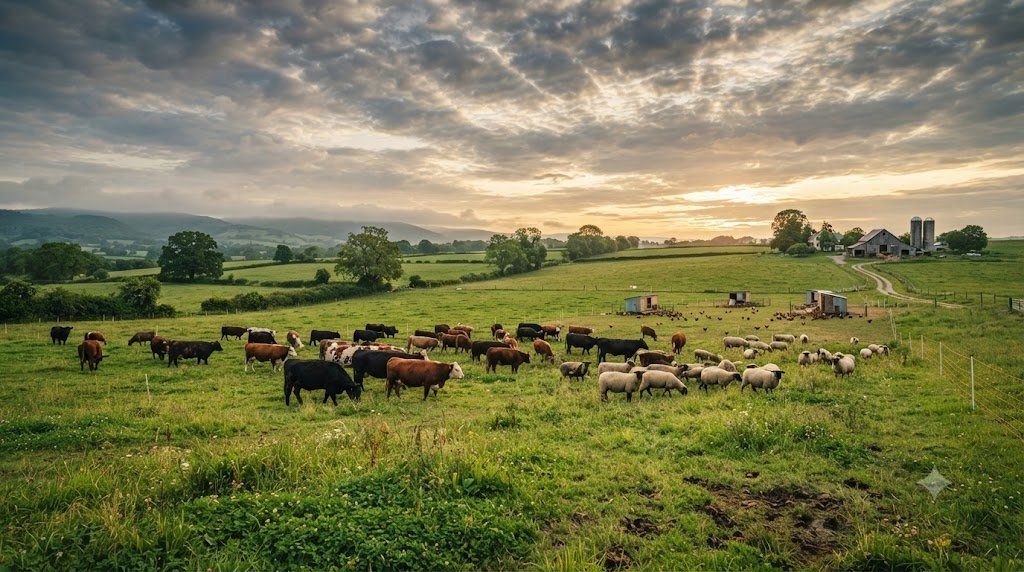
Modern industrial agriculture fractured this natural harmony by segregating livestock into single-species monocultures. However, regenerative small farm systems harness the Ecological Stacking Principle—integrating cattle, sheep, goats, and pastured poultry across identical land bases. Rather than competing for the same forage, diverse livestock species exploit complementary vertical and biological niches within the pasture ecosystem.
Cattle are bulk, non-selective grazers that utilize a muscular tongue to sweep tall, fibrous grass swards (6 to 12 inches high) into their mouths, ignoring low-growing weeds and thorny briars. Sheep are selective fine-particle grazers, utilizing sharp incisors and split lips to clip broadleaf forbs, clovers, and dandelions close to the ground (2 to 4 inches). Goats are intermediate browse selectors, preferring woody brush, multiflora rose, thistles, and tree leaves harvested at eye level or while standing upright on their hind legs. Pastured poultry follow, scratching apart manure piles to consume fly pupae, ticks, and beetle larvae while depositing high-nitrogen, phosphorus-rich guano.
Carcass Meat Production Density per Acre
Empirical research demonstrates that integrating multiple species increases total marketable meat yield per acre by 20% to 35% compared to grazing cattle alone, without increasing purchased fertilizer or feed inputs. A single pasture that supports 10 mature beef cows can comfortably support an additional 20 ewes and 15 meat does because the small ruminants harvest forage species that cattle reject.
Furthermore, multi-species grazing eliminates pasture weed pressure naturally. Weeds are simply plants whose nutritional attributes are rejected by a single grazing species; when sheep and goats are added, thistles, dock, and briars are transformed into valuable livestock gain, eliminating the need for toxic chemical pasture herbicides.
Never allow multi-species groups to remain in any single paddock longer than 3 consecutive days. Moving animals before day 4 prevents them from biting re-emerging plant shoots and keeps livestock ahead of the 4-day hatching cycle of internal parasite eggs.
2. The Leader-Follower Fluer Rotation Architecture
Executing multi-species grazing requires choosing between co-grazing (running species together as a single mob) or leader-follower sequential grazing (rotating species through paddocks in a structured sequence). While co-grazing saves fencing labor, leader-follower systems provide superior nutritional precision.
In a premier Leader-Follower Rotation Sequence:
The Leaders (High-Value Producers): Animals with the highest metabolic nutritional demands—such as dairy cows, lactating ewes, or grass-finishing steers—enter the pristine paddock first. They graze the top 30% to 40% of the sward, harvesting tender, high-sugar, protein-rich leaf tips that maximize milk yield or average daily gain.
The Followers (Maintenance Stock & Weed Specialists): After 24 to 48 hours, the leaders move to the next paddock. The followers—gestating beef cows, dry ewes, and meat goats—enter the grazed paddock. They consume the intermediate canopy, clipping coarse grasses, grazing broadleaf weeds, and defoliating woody briars down to the 3.5 to 4-inch residual target.
The Sanitizers (Pastured Poultry): Three to four days after the four-legged ruminants vacate the paddock, mobile poultry coops (egg layers or broiler chicken tractors) enter. The timing is exact: fly larvae within ruminant manure pats have developed into plump pupae but have not yet emerged as adult flies. Chickens scratch the manure pats flat to feast on the fly larvae, breaking the livestock fly pest cycle while distributing manure fertility uniformly across the grass sward.
3. Biological Parasite Vacuums: The Cross-Species Immunity Advantage
Internal parasitism—particularly the devastating barber pole worm (Haemonchus contortus) in sheep and goats—is the primary cause of small ruminant mortality. However, the majority of gastrointestinal nematodes exhibit strict host specificity.
Haemonchus contortus, Teladorsagia circumcincta, and Trichostrongylus colubriformis are obligate parasites of small ruminants (sheep and goats); they cannot survive, mature, or reproduce within the gastrointestinal tract of cattle or horses. Conversely, major bovine parasites (Ostertagia ostertagi, Cooperia oncophora) do not infect sheep or goats.
When cattle graze pastures that have been contaminated with sheep and goat parasite larvae, the cattle ingest millions of microscopic L3 small ruminant larvae. In the bovine rumen, these larvae are killed and digested as high-protein feed, completely removing them from the pasture ecosystem. Following cattle with small ruminants achieves the identical cleansing effect for cattle parasites, creating a natural biological parasite vacuum that dramatically reduces or eliminates the need for chemical anthelmintic drugs.
4. Soil Microbiology, Carbon Sequestration, and Manure Cycling
Soil biology thrives on biological diversity. A pasture subjected exclusively to single-species grazing receives a uniform, monotonous biological input. In contrast, multi-species grazing introduces a rich diversity of gut microbes, digestive enzymes, and physical trampling impacts.
Cattle deposit large, moist manure pats that create localized anaerobic micro-environments favored by earthworms and dung beetles. Sheep and goats deposit dry, concentrated fecal pellets rich in phosphorus and potassium that break down slowly, releasing nutrients over months. Poultry deposit high-nitrogen uric acid and calcium that stimulate rapid foliar plant greening.
Furthermore, the diverse hoof action—heavy bovine hooves that press plant residue into the soil surface, sharp sheep hooves that aerate the top layer, and chicken scratching that incorporates organic matter—stimulates mycorrhizal fungal networks. Deep root recovery cycles pump liquid carbon exudates into the rhizosphere, building stable soil humus and sequestering atmospheric carbon at rates of 1.5 to 3.0 tons per acre annually.
5. Fencing Engineering for Multi-Species Containment
Designing fencing that simultaneously contains 1,400-pound cattle, agile climbing goats, wool-insulated sheep, and vulnerable poultry is the greatest physical challenge of multi-species farming.
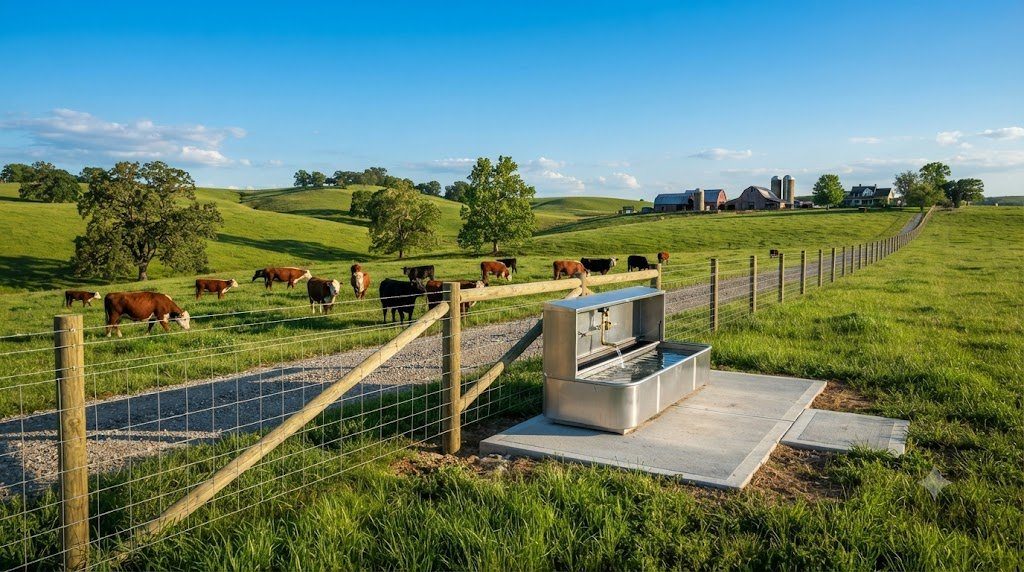
Perimeter Boundary Fencing: The external farm boundary must be completely predator-proof and stock-tight. The premier standard is a 48-inch woven wire fence (4×4-inch mesh) topped with a single high-tensile electrified wire at 52 inches (to deter jumping cattle and predators) and an electrified offset wire at 8 inches off the ground (to prevent digging predators and rooting swine).
Internal Rotational Cross-Fencing: For flexible internal subdivisions, deploy electrified sheep/goat netting (electro-netting) or 3 to 4 strands of temporary polywire. When training multi-species mobs to polywire, install strands at 8 inches (for goats/sheep), 18 inches, and 34 inches (for cattle). Maintain fence voltage above 5,000 to 7,000 volts with low-impedance energizers; high voltage is mandatory to command psychological respect across all species.
6. Water and Mineral Infrastructure: The Copper Toxicity Challenge
Co-grazing multiple livestock species requires vigilant management of mineral supplementation, centered upon the critical biological phenomenon of copper toxicity in sheep.
While cattle and goats require high dietary copper (15 to 80 ppm) to maintain immune function and hair pigmentation, sheep lack efficient biliary copper excretion mechanisms. Ingesting feed or mineral mixes formulated for cattle or goats causes cumulative copper accumulation in the ovine liver, culminating in fatal hemolytic crises and kidney failure.
The Mineral Separation Protocol: In mixed-species herds, always provide sheep-formulated loose mineral (certified copper-free) in the open pasture accessible to all animals. To satisfy the higher copper requirements of cattle and goats, construct raised mineral feeders that only tall cattle can reach, or administer individual slow-release Copper Oxide Wire Particle (COWP) boluses to goats twice annually during handling.
7. Predator Defense: Livestock Guardian Animals in Multi-Species Systems
Pasture-based multi-species systems attract intense predator attention from coyotes, feral dogs, bobcats, and aerial raptors (foxes, eagles, hawks targeting young poultry and lambs).
Integrating bonded Livestock Guardian Dogs (LGDs)—such as Great Pyrenees, Anatolian Shepherds, or Akbash—provides complete, around-the-clock biological defense. Pups must be cross-bonded during socialization (8 to 16 weeks of age), learning to live peacefully with cattle, sheep, goats, and poultry simultaneously. A bonded LGD views the entire multi-species mob as its family, aggressively driving off mammalian predators and barking warning alarms at low-flying raptors.
In addition to LGDs, mature beef cattle (particularly protective cows with nursing calves) naturally intimidate coyotes and stray dogs. Grazing sheep and goats in close proximity to mature cattle provides a powerful secondary ‘herd shield’ that discourages predators from approaching the flock.
8. Enterprise Economics: Risk Diversification and Financial Resilience
The commercial genius of multi-species small farming lies in financial risk diversification. Monoculture livestock operations are acutely vulnerable to single-commodity market crashes, breed-specific disease outbreaks, and weather extremes.
In a multi-species enterprise, cash flow is smoothed throughout the entire calendar year. Broiler chickens and pastured eggs generate rapid weekly cash flow starting in spring; holiday market lambs and meat goat kids generate concentrated lump-sum revenue in autumn and winter; while grass-finished beef steers provide substantial capital injections at 20 to 24 months.
Furthermore, enterprise resilience is buffered against climate extremes. During wet years that produce heavy, rank grass, cattle thrive; during drought years when grasses languish but deep-rooted weeds and woody shrubs persist, goats and hair sheep flourish. This biological and financial stacking creates an extraordinarily robust, profitable, and ecologically regenerative small farm enterprise.
9. Soil Mineralization, Humus Formation, and Ecological Succession
The cumulative ecological impact of multi-species rotational grazing is the rapid biological acceleration of soil humus formation and mineral cycling. As diverse livestock deposit varied manures, urine compounds, and saliva enzymes across the pasture sod, soil microbial populations experience dramatic taxonomic diversification. Fungal-to-bacterial biomass ratios shift toward balanced equilibrium, creating the ideal soil biology for perennial cool-season grasses and nitrogen-fixing legumes.
Earthworm populations proliferate rapidly beneath multi-species dung pats, their continuous vertical burrowing action aerating dense subsoil compaction pans and creating channels for deep root penetration and rainwater infiltration. Infiltration tests demonstrate that soils managed under multi-species mob grazing absorb over 4 to 6 inches of rainfall per hour without surface runoff, virtually eliminating soil erosion while charging subterranean groundwater tables.
This biological regeneration initiates positive ecological succession: fragile, shallow-rooted annual weeds are progressively outcompeted by dense, resilient perennial swards of orchardgrass, perennial ryegrass, meadow fescue, and deep-taprooted chicory and bird’s-foot trefoil. The farm transitions from a fragile system dependent on expensive synthetic fertilizers and chemical herbicides into a self-renewing, highly productive, biologically independent pastoral ecosystem.
Multi-Species Grazing Compatibility and Ecological Synergies
The following comparative matrix outlines dietary preferences, grazing habits, parasite interactions, and fencing demands across livestock species:
Frequently Asked Questions: Practical Livestock Management
❓ How can I prevent sheep from consuming high-copper cattle mineral in a mixed herd?
Place sheep-safe (copper-free) mineral out in common pasture areas where all species graze. To provide necessary copper to cattle, install a cattle mineral feeder elevated 36 inches off the ground inside a creep-restricted pen with a high hurdle that cattle can reach over but sheep and goats cannot access.
❓ Can cattle accidentally injure sheep or lambs when co-grazing together?
Mature docile cattle rarely injure sheep intentionally, but curious cattle can inadvertently step on newborn lambs sleeping in tall grass. The best management practice is to separate ewes with newborn lambs under 2 weeks old into dedicated lambing paddocks before re-integrating into multi-species herds.
❓ How many days after ruminants leave should chickens enter a pasture paddock?
Move pastured chickens into the grazed paddock 3 to 4 days after cattle or sheep vacate. This window allows fly eggs in manure pats to hatch into fat, protein-rich pupae without giving them time to emerge as adult flying insects.
❓ What is the stocking ratio when calculating multi-species pasture capacity?
A standard animal unit (AU) represents one 1,000-lb beef cow. In multi-species systems, you can safely stock 1 mature beef cow PLUS 2 to 3 hair sheep and 1 to 2 meat goats per animal unit without exceeding forage capacity, because of their non-competing dietary preferences.
Summary: Comprehensive Implementation Protocols
To successfully integrate these management practices, livestock producers must balance biological animal needs with physical infrastructure and strict financial accountability. Routine observation, objective record-keeping, and preventative herd health protocols yield sustained enterprise longevity, reduced veterinary interventions, and consistent farm profitability across seasonal cycles.