- Understanding monogastric porcine digestion: balancing standardized ileal digestible (SID) amino acids rather than crude protein alone.
- Targeting lysine as the first limiting amino acid to drive lean muscle tissue accretion across growth phases.
- Formulating phased feeding programs: starter, grower, finisher, and breeding herd rations.
- Evaluating the nutritional contribution of pasture forages, brassicas, and legume swards in reducing grain costs.
- Implementing on-farm feed milling, grain particle size optimization (600-700 microns), and mycotoxin binder strategies.
1. Monogastric Porcine Digestive Physiology and Energy Metabolism
Pigs are anatomical monogastrics possessing a simple, non-ruminant stomach engineered for enzymatic digestion of concentrated dietary starches, proteins, and fats. Unlike cattle and sheep—whose rumen microbes ferment structural cellulose into volatile fatty acids and synthesize high-quality microbial protein—pigs cannot synthesize essential amino acids or digest heavy structural lignin.
The porcine digestive tract relies on hydrochloric acid and pepsin in the stomach to initiate protein denaturation, followed by pancreatic enzymes (trypsin, chymotrypsin, amylase, lipase) in the duodenum and jejunum. Nutrient absorption occurs primarily across the highly vascularized microvilli of the small intestine. While the cecum and large intestine harbor an anaerobic microbial population capable of fermenting soluble dietary fiber into volatile fatty acids, this hindgut fermentation contributes only 5% to 15% of a growing pig’s daily maintenance energy.
Consequently, swine nutrition must deliver pre-formed, highly bioavailable amino acids, essential fatty acids, vitamins, and minerals. Energy metabolism is measured as Net Energy (NE), which accounts for the energy lost in feces, urine, and the heat increment of digestion, providing the most accurate predictor of lean muscle accretion and carcass fat deposition.
The First Limiting Amino Acid: Lysine and the Ideal Protein Concept
Formulating swine diets based on Crude Protein (CP) percentage alone is obsolete and economically wasteful. Excess dietary protein that does not match the pig’s amino acid requirements is deaminated in the liver; the nitrogen is excreted as urinary urea, which wastes metabolic energy, increases water consumption, and causes severe environmental ammonia emissions.
Swine nutritionists formulate diets around the Ideal Protein Concept, where all essential amino acids are balanced as a precise mathematical percentage relative to Lysine—the first limiting amino acid for swine growth. If dietary lysine is deficient, protein synthesis ceases immediately, and all other amino acids are wasted, regardless of total crude protein concentration. The optimal ratio requires Threonine at 60% to 65% of lysine, Methionine + Cysteine at 55% to 60%, and Tryptophan at 18% to 20% of lysine.
Mill grain to an average geometric particle size of 600 to 700 microns using a hammer mill or roller mill. Grinding finer than 500 microns causes fatal gastric ulcers and feed bridging in bins, while grinding coarser than 850 microns reduces feed digestibility by 5% to 8%.
2. Phased Feeding Programs: Nutritional Specifications from Weaning to Finish
A pig’s physiological nutrient requirements shift continuously as it matures. Young weanling pigs exhibit rapid lean muscle protein synthesis and possess high amino acid demands, while finishing pigs have lower protein requirements and channel excess dietary energy into adipose fat deposition. Implementing phase feeding—adjusting ration formulations across 3 to 4 distinct growth phases—optimizes growth velocity while minimizing feed costs.
Phase 1: Nursery / Starter (15 to 45 lbs): Newly weaned piglets experience profound digestive stress as they transition from liquid milk to dry solid grain. Starter diets must deliver 20% to 22% Crude Protein, 1.35% to 1.45% Standardized Ileal Digestible (SID) Lysine, and 1,500 kcal/lb NE. Incorporate highly digestible specialty ingredients: whey powder, steam-rolled oats, extruded full-fat soybeans, and acidifiers (citric or fumaric acid) to lower stomach pH.
Phase 2: Grower (45 to 130 lbs): During this phase of maximum skeletal frame and lean muscle expansion, pigs achieve exceptional feed conversion efficiency (FCR 2.2 to 2.5). The grower diet provides 16% to 18% CP, 1.05% to 1.15% SID Lysine, and 1,120 kcal/lb NE, utilizing corn or barley balanced with soybean meal and complete swine premix.
Finisher and Gestating Sow Nutritional Profiles
Phase 3: Finisher (130 to 280 lbs): As lean muscle growth plateaus, protein density can be safely reduced to prevent costly feed waste. Finisher rations provide 13% to 14% CP, 0.75% to 0.85% SID Lysine, and 1,150 kcal/lb NE. To maintain carcass marbling while preventing excessive soft backfat in pastured heritage pigs, replace 10% to 20% of corn with fibrous feedstuffs such as wheat middlings, beet pulp, or ground oats.
Breeding Herd Nutrition: Non-lactating gestating sows require tightly restricted feeding (4.5 to 5.5 lbs daily of a 13% CP, high-fiber maintenance diet) to prevent obesity, which causes small litters, farrowing complications, and crushed piglets. In contrast, lactating sows nursing 10+ piglets require ad-libitum feeding of a nutrient-dense 17% CP, 0.95% SID Lysine diet, consuming 12 to 18 pounds of feed daily to sustain heavy milk production.
3. The Nutritional Contribution of Pasture, Forages, and Farm Gleanings
A common misconception in pastured pork production is that pigs can thrive on grass alone. Because pigs lack a functional rumen, their digestive tracts cannot break down high-lignin grasses to fulfill metabolic energy demands; pigs fed only grass will suffer severe muscle wasting and emaciation.
However, well-managed, vegetative pasture swards deliver invaluable nutritional contributions, offsetting 15% to 25% of total concentrated feed requirements while providing vital micronutrients and exercise.
The premier pasture forages for swine are legumes and brassicas. Young, vegetative alfalfa (Medicago sativa) and ladino clover (Trifolium repens) contain 20% to 24% crude protein and high concentrations of bioavailable lysine, calcium, and Vitamin A. Annual forage crops—such as forage rape, daikon radishes, fodder beets, and sweet potatoes—provide highly digestible carbohydrates that pigs readily harvest, significantly lowering purchased commercial feed bills.
4. Mineral Nutrition and Macromineral Balancing: Calcium, Phosphorus, and Phytase
Mineral balancing is critical for rapid skeletal mineralization and metabolic health. Cereal grains (corn, wheat, barley) are naturally deficient in calcium and sodium, while the phosphorus they contain is largely bound as phytate phosphorus.
Pigs lack endogenous phytase enzymes to cleave phytate molecules, resulting in poor phosphorus absorption and heavy phosphorus excretion in manure, which causes environmental water pollution. To overcome this, modern swine rations incorporate exogenous microbial phytase enzyme (500 to 1,000 FTU/kg feed). Phytase breaks down dietary phytate complexes, releasing bound phosphorus, calcium, and trace minerals, reducing required supplemental dicalcium phosphate by 30% to 50%.
Maintain a strict dietary Total Calcium-to-Available Phosphorus ratio between 1.2:1 and 1.5:1. An improper ratio or calcium deficiency triggers nutritional rickets in growing pigs and acute lactational osteoporosis (downer sow syndrome) in heavy-milking sows, resulting in pelvic and femoral fractures.
5. Feed Conversion Ratio (FCR) Optimization and Bunk Management
Feed represents 65% to 75% of the total operating cost in commercial pork production. The Feed Conversion Ratio (FCR)—pounds of feed consumed per pound of live body weight gain—serves as the primary indicator of economic efficiency.
Target commercial FCR benchmarks range from 2.5 to 3.0 for confinement hybrids and 3.2 to 3.8 for outdoor heritage pigs. Every 0.1 improvement in FCR saves 25 to 30 pounds of feed per finished hog.
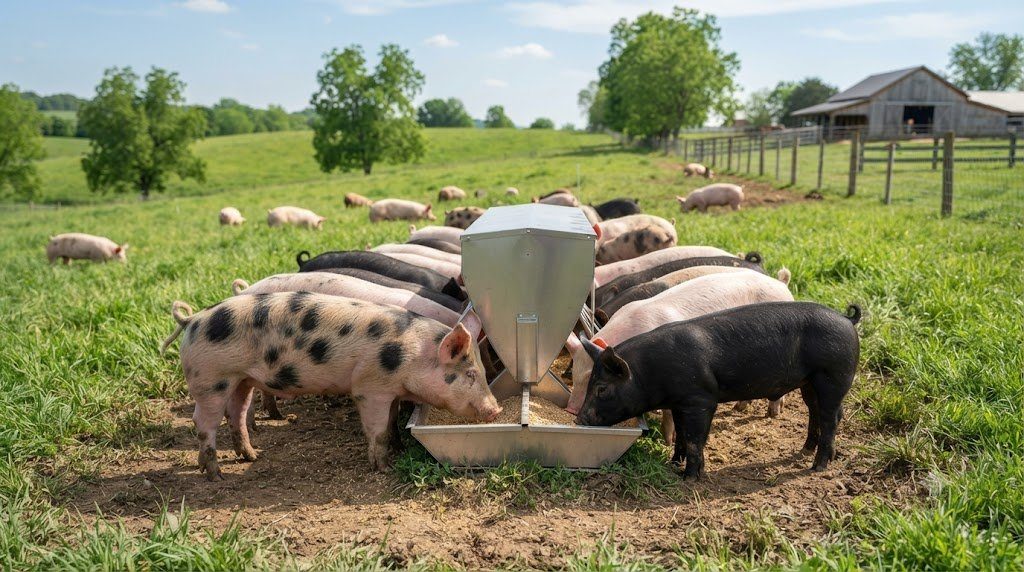
Bunk design and feeder adjustment directly dictate FCR. Studies demonstrate that poorly adjusted gravity feeders waste 10% to 20% of all feed delivered, as pigs root feed out of troughs onto the ground where it is trampled into mud and manure. Adjust feeder flow gates so that feed covers only 40% to 50% of the trough floor surface; feed should be visible, but pigs must work their snouts into the trough to obtain feed without allowing grain accumulation.
6. Alternative and Waste Stream Feeding: Brewery Grains, Dairy Whey, and Bakery Surplus
Producers can dramatically lower feed costs and build regional circular economy partnerships by incorporating food manufacturing coproducts into pastured swine rations.
Liquid Dairy Whey: Sourced from local artisan creameries, liquid cheese whey contains 5% to 6% dry matter rich in high-quality lactose sugar, whey proteins, and bioavailable minerals. Pigs can consume 2 to 5 gallons of liquid whey daily, replacing up to 25% of grain dry matter and imparting exceptional sweetness and tenderness to pork.
Spent Brewer’s Grains: Breweries generate massive volumes of wet spent barley grains (BSG). While high in fiber and moisture (75% water), dried or fresh BSG contains 24% to 28% crude protein. Feed spent grains to mature sows and finishing pigs (limiting inclusion to 15% to 20% of dry matter to prevent digestive upset).
Biosecurity Warning on Swill / Food Waste: Federal and state agricultural regulations strictly prohibit feeding mammalian meat or unboiled restaurant plate scraps to pigs to prevent catastrophic global viral disease outbreaks, specifically African Swine Fever (ASF) and Foot-and-Mouth Disease (FMD). Any commercial food waste containing animal products must be cooked at 212°F (100°C) for a minimum of 30 minutes in licensed facilities.
7. Mycotoxin Contamination, Binders, and Feed Storage Hygiene
Pigs are the most sensitive domesticated livestock species to fungal mycotoxins produced by field molds (Fusarium, Aspergillus, Penicillium) contaminating corn, barley, and cereal grains.
Zearalenone: An estrogenic mycotoxin that severely disrupts swine reproduction. Concentrations as low as 1 to 2 ppm cause hyperestrogenism, swelling and reddening of the vulva in prepubertal gilts, embryonic death, small litter sizes, and prolapses in gestating sows.
Deoxynivalenol (DON / Vomitoxin): Causes severe feed refusal, vomiting, and gastric lesions. Levels exceeding 1.0 ppm cause a 20% drop in feed intake; levels above 5.0 ppm cause complete feed refusal and rapid weight loss.
To safeguard herd health, test all bulk grain shipments with rapid mycotoxin test strips prior to unloading. Store grain in sealed, waterproof bins with aeration fans to maintain moisture below 14%. When feeding grains with low-level mycotoxin contamination, incorporate broad-spectrum mycotoxin binders (aluminosilicates, hydrated sodium calcium aluminosilicate [HSCAS], and modified yeast cell wall glucomannans) at 2 to 4 pounds per ton of feed to physically bind toxins in the gut.
8. Enterprise Feed Budgeting and Custom Farm Milling Economics
A structured feed budget outlines exact tonnage requirements for a commercial batch of pigs from birth to slaughter.
To bring a pig from weaning (15 lbs) to market finish (275 lbs), the animal will consume approximately 800 to 950 pounds of complete feed: 40 lbs of Phase 1 starter, 180 lbs of Phase 2 grower, and 650 lbs of Phase 3 finisher.
Investing in an on-farm tractor-driven PTO grinder-mixer or automated electric hammer mill allows producers to purchase bulk commodity grains (whole corn, barley, roasted soybeans) and mix custom rations on-site. Custom farm milling eliminates retail feed bagging and distribution markups, reducing total feed costs by $60 to $100 per ton ($25 to $40 per finished pig) and providing complete control over ingredient quality and formulation precision.
Swine Nutritional Specifications Across Growth and Reproductive Phases
The following nutritional matrix outlines standard dietary specifications for commercial and heritage swine across production phases:
Frequently Asked Questions: Practical Livestock Management
❓ Why is Lysine formulated as a percentage rather than total crude protein in pig diets?
Pigs do not require crude protein per se; they require individual essential amino acids. Lysine is the first limiting amino acid in cereal-based diets. If dietary lysine is deficient, protein accretion stops completely, and all other amino acids are wasted, regardless of total crude protein percentage.
❓ Can pigs digest whole raw soybeans without roasting or extrusion?
No. Raw soybeans contain potent anti-nutritional factors: trypsin inhibitors and lectins. Ingesting raw soybeans deactivates pancreatic digestive enzymes, causing severe pancreatic hypertrophy, diarrhea, and stunted growth. Soybeans must be thermally processed (roasted or extruded at 280°F to 300°F) to denature trypsin inhibitors before feeding to swine.
❓ How much feed does an outdoor heritage pig consume from birth to market slaughter?
An outdoor heritage pig harvested at 275 pounds live weight consumes approximately 850 to 950 pounds of complete balanced feed over its 7 to 8-month lifetime, achieving an overall lifetime feed conversion ratio of 3.3 to 3.7 lbs of feed per lb of gain.
❓ What causes stomach ulcers in commercial pigs, and how can they be prevented?
Gastric ulcers (ulceration of the pars esophagea) are caused by grinding grain too finely (<500 microns), pelleted high-starch diets, and feed disruptions. The fluid stomach contents lack protective fiber layering, allowing hydrochloric acid to erode the non-glandular esophageal mucosa. Prevent ulcers by milling grain to 650-700 microns and adding 5% coarse fiber.
Summary: Comprehensive Implementation Protocols
To successfully integrate these management practices, livestock producers must balance biological animal needs with physical infrastructure and strict financial accountability. Routine observation, objective record-keeping, and preventative herd health protocols yield sustained enterprise longevity, reduced veterinary interventions, and consistent farm profitability across seasonal cycles.